

Truck Financing After a Bankruptcy or Repossession
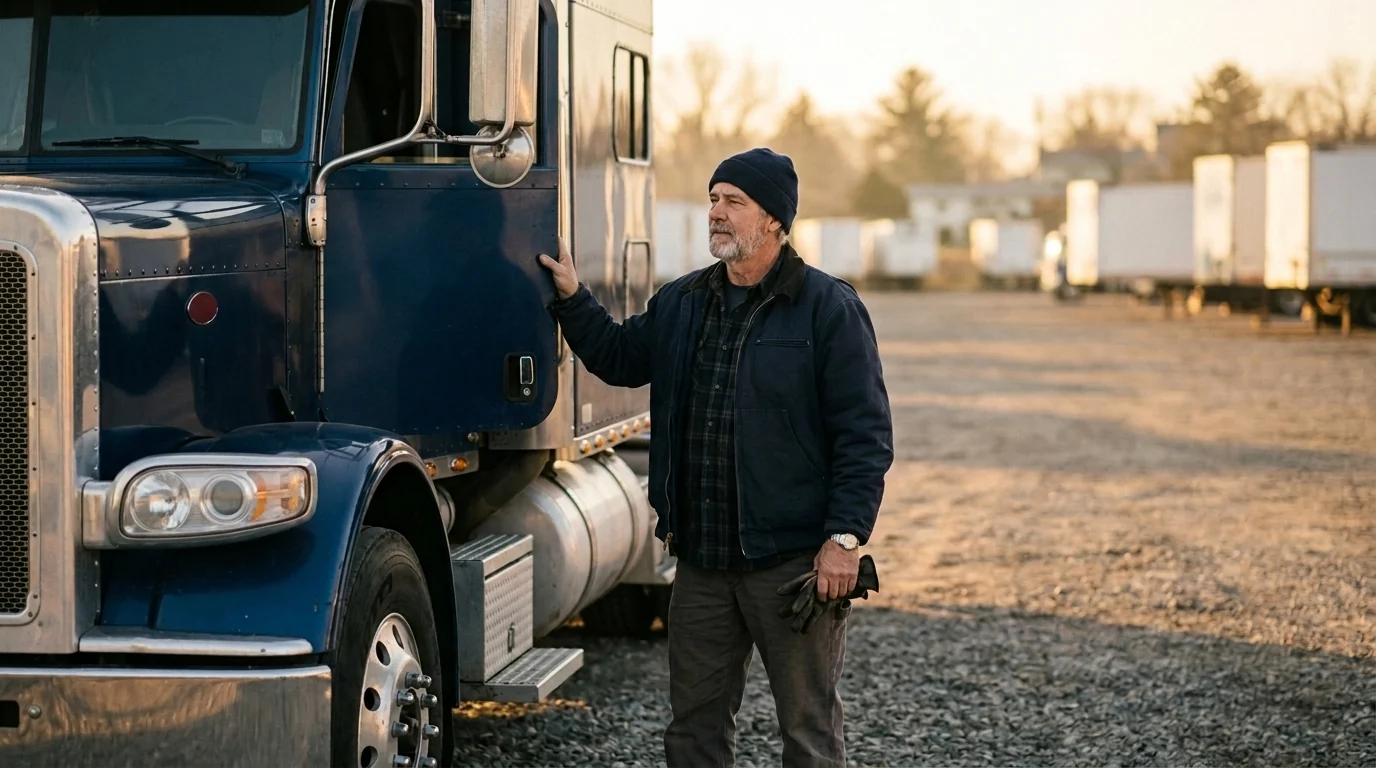
If you own the trucks, a bankruptcy or a repossession changes how your next purchase gets read. This is about buying a vehicle: a carrier, an owner-operator, or a distributor financing a Class 8 tractor after an adverse event already landed on the file. In the 12 months ending March 31, 2026, business bankruptcy filings rose 11.4% to 25,960, and total filings rose 11.9% to 591,850 (Administrative Office of the U.S. Courts, April 2026).
Most of that happened during a freight cycle that took out operators who did nothing wrong.
What almost nobody tells you plainly is what the event does now. How long it reports, which date the clock started on, whether the deficiency balance is even correct, and what you can show a lender that carries the weight the score no longer carries.
That is the whole post.
> Key Takeaways
> - Federal law permits reporting a bankruptcy for up to 10 years from the order for relief, for every chapter, and most other adverse items for 7 (15 U.S.C. 1681c).
> - Lenders season from the discharge date, not the filing date. Chapter 7 discharge typically arrives about four months after filing; a Chapter 13 plan runs three to five years first (U.S. Courts).
> - A commercial truck is repossessed and sold under UCC Article 9, and the secured party owes you a written explanation of any deficiency (UCC 9-616).
> - Partial approval is the common outcome for small firms: 42% got everything they sought, 36% got some or most, 22% got none (Federal Reserve Banks, 2026 report). All financing is subject to approval and eligibility.
Talk to our team about financing your next truck
What does a credit event actually do to a truck financing file?
It changes the shape of the deal rather than deciding it. In the Federal Reserve Banks' 2026 Report on Employer Firms, 42% of applicant firms received the full amount they sought, 36% received some or most of it, and 22% received none (Federal Reserve Banks, 2026 report). A file with an event on it usually lands in that middle band.
Underwriting is reading three things after an event, and none of them is the event itself. How recent is it. Is it resolved or still open. What has the business done since.
Secured equipment credit behaves differently from a credit card here, because a titled asset stands behind the loan. The truck is being underwritten alongside you. That does not erase an event, but it makes the question structure rather than a flat yes or no.
One thing worth saying out loud: 91.5% of US motor carriers run 10 or fewer trucks (American Trucking Associations, June 2025). At that size the personal file and the business file are usually read together, so an event rarely stays on one side of the wall.
This post starts one step past the general rules. If you want the baseline a carrier file gets read against, the sibling post covers whose credit gets pulled, which scales get used, and what sits next to the score. Nothing here restates it.
Eos Loan does not publish a score cutoff and does not apply a fixed waiting period. Every application is subject to approval and eligibility.
How long does a bankruptcy stay on a carrier's credit file?
Up to 10 years from the date of entry of the order for relief or the adjudication, for any chapter. That is the statute, not a guideline (15 U.S.C. 1681c), and the CFPB states the same 10-year window (CFPB). The familiar "Chapter 13 is seven years" figure is a voluntary credit bureau practice sitting on top of the law.
That distinction gets stated wrong on nearly every page ranking for this question. Ten years is what federal law permits for both chapters. Seven is what the bureaus chose to do for Chapter 13. A policy can change. A statute is the outside boundary.
Now the second clock, and it is the one that actually decides when you can borrow. Chapter 7 discharge is typically granted about four months after the petition is filed, generally 60 to 90 days after the first date set for the meeting of creditors (U.S. Courts, Bankruptcy Basics). A Chapter 13 repayment plan runs three to five years before discharge.
So two carriers who filed in the same week can be years apart on the only date a lender is counting from. The report ages from the filing date. Lenders season from the discharge date. Say that back to yourself before you assume you are further behind than you are.
For a carrier that reorganized rather than liquidated, Subchapter V is the small-business track, and its debt limit stood at $3,424,000 as of January 1, 2026 (DOJ U.S. Trustee Program).
What does a truck repossession do that a late payment does not?
It reports for up to seven years, and the clock runs from the first missed payment that triggered it rather than from the day the truck was taken (Experian, 2026; seven-year limit per 15 U.S.C. 1681c). For a carrier who fell behind for six or eight months first, the clock is further along than it feels.
The tradeline is only half of it. The other half is the deficiency: whatever the sale did not cover, which can sit in collections and age on its own timeline from the original delinquency date, not from the day a collector bought the account.
Here is the part that gets missed. A commercial tractor is not a consumer car. It is business collateral, disposed of under UCC Article 9. Every aspect of the sale has to be commercially reasonable (UCC 9-610, UCC 9-627), and after disposing of the collateral the secured party must send a written explanation of how the deficiency or surplus was calculated (UCC 9-616). Most pages ranking for this question recycle consumer auto-repossession advice, which is the wrong body of law for a Class 8 truck.
So if a deficiency is sitting on your file and you never received an explanation of calculation, that is a fair question to ask in writing of whoever holds the balance. Reconciling the reported sale price against what the unit was actually worth is worth doing before you treat the number as settled. State law and case facts vary, so talk to a bankruptcy or commercial attorney before acting on any of this. Nothing here is legal advice.
Knowing what your current truck is actually worth as collateral is useful on both sides of that conversation.
Ask about flexible terms on a truck purchase
When can a carrier realistically apply again?
There is no federal waiting period for a business equipment loan after a discharge, and no industry-wide seasoning rule every lender follows. What gets read is elapsed time since discharge plus what the file shows since then. In the 2026 Federal Reserve Banks survey, the middle outcome for applicant firms was partial funding rather than denial, with 36% receiving some or most of what they sought (Federal Reserve Banks, 2026 report).
"Wait two years" is a guess that got repeated until it sounded like a rule. It is not one.
A few real constraints do exist. If a Chapter 13 plan is still active, the debtor generally needs the trustee's or the court's permission before taking on new debt, so that is a call to your attorney before it is a call to a lender. An open deficiency reads worse than a closed one of the same age, because open means unsettled. And applying with nothing new in the file since the last look just adds an inquiry.
The useful question is not "how long do I wait." It is "what will be different in my file when I apply." If the answer is nothing, wait until it is something.
If an application does come back declined, what to do after a financing denial walks through how to find out which part of the file drove it.
!Business bank statements and operating documents open on a laptop at a yard office desk in daylight.
What evidence rebuilds a carrier file fastest?
Documents carry the weight the score no longer carries. In July 2026, ATRI reported truckload and refrigerated operating margins below 1.0% for 2025, flatbed at an operating loss of negative 0.5%, and carriers cutting truck counts by 2.4% (ATRI, July 2026). At those margins, no lender is underwriting a projection. They want deposits.
Six things do most of the work:
1. Twelve to twenty-four months of business bank statements showing consistent settlement deposits, in the business account, legible to a stranger reading them cold.
2. Current commercial auto and cargo insurance, active today, in the business name.
3. Active operating authority in good standing, with UCR and required filings current.
4. Committed freight or a named lane you can document, with a broker or shipper relationship behind it.
5. Any secured trade line paid on time since the event, including a small one. Clean payment history on something modest still reports.
6. A short written explanation of what happened and what closed it.
On that last one: two or three sentences, factual, no apology. What happened, what date it closed, what changed. Underwriters read hundreds of files, and a plain account is more credible than a long one.
> What I see on rebuilt carrier files: after a discharge, the strongest thing in a file is rarely a score. It is twelve to twenty-four months of boring bank statements with settlement deposits that match the freight the carrier described, plus current insurance and a lane they can name. That is a pattern I have watched across applications, not an approval rule, and every file is still subject to approval and eligibility.
Two related pieces are worth reading next: keeping authority in good standing, and how much money down changes the deal.
Does the truck you pick change what happens next?
Yes, because the truck is the collateral. A secured lender is underwriting the unit's expected resale value alongside your file, and on a rebuilt file a tractor that holds value predictably does more work than it otherwise would. Year, mileage, spec and service records all matter more here than they would on a clean file.
A second point that costs carriers money: the cheapest unit is not always the easiest to finance. A documented truck with records reads better than a bargain nobody can verify, and a truck you can keep loaded beats a cheaper one that sits between loads.
Expect the down payment question. Third-party guides note that borrowers with weaker credit are commonly asked for a larger share down, sometimes around 30% versus 10 to 15% for stronger files (Bankrate, April 2025). That is an industry pattern, not an Eos Loan requirement.
How age and mileage change the terms goes deeper here, and the pillar covers the whole purchase: truck fleet financing for carriers.
Eos Loan is a direct lender with flexible terms and no dealer fee. One team holds the credit decision from application to funding, which matters when a file needs explaining, because the person reading the explanation is the person deciding.
!A used Class 8 tractor parked on a dealer lot in bright daylight.
See what financing a fleet expansion could look like
Or call +1 833-989-3737 to talk through a truck purchase with our team.
See how truck fleet financing from Eos Loan is structured.
question: "How long after a bankruptcy discharge can a carrier finance a truck?",
answer: "No federal or industry-wide waiting period applies to business equipment financing. Lenders season from the discharge date rather than the filing date, and read what the file shows since then: bank statements, current insurance, authority in good standing. Every application is subject to approval and eligibility."
},
{
question: "How long does a bankruptcy stay on a credit report?",
answer: "Up to 10 years from the date of entry of the order for relief or adjudication, for any chapter, under 15 U.S.C. 1681c. Credit bureaus voluntarily remove Chapter 13 after seven years, which is company policy rather than law. The CFPB states the same 10-year statutory window."
},
{
question: "Do I still owe money after a truck is repossessed?",
answer: "Often yes. After the secured party sells the unit, any shortfall between the sale proceeds and the balance owed is a deficiency. Under UCC 9-616 the secured party must send a written explanation of how that number was calculated, and the sale itself must be commercially reasonable."
},
{
question: "When does the seven-year clock on a repossession start?",
answer: "From the first missed payment that led to the repossession, not the day the truck was taken (Experian, 2026). A related collection account ages from the original delinquency date as well, not from the date a collection agency acquired the balance."
},
{
question: "Does a repossession or bankruptcy show up on business credit or personal credit?",
answer: "Frequently both, because most small carriers sign a personal guarantee and 91.5% of US carriers run 10 or fewer trucks (American Trucking Associations, June 2025). Our post on truck financing credit requirements covers how the two files get read side by side."
}
]} />
What the file shows now
A credit event is a date and a set of facts. It is not a verdict on the operator.
- Federal law permits 10 years of bankruptcy reporting for any chapter. The seven-year Chapter 13 figure is bureau policy, not statute.
- Lenders season from the discharge date. Chapter 7 typically reaches it in about four months, Chapter 13 in three to five years.
- A repossession's seven-year clock starts at the first missed payment, not the tow date.
- A commercial truck is disposed of under UCC Article 9, and you are owed a written explanation of any deficiency.
- Documents rebuild a file faster than time alone: bank statements, active insurance, authority in good standing, a named lane.
Eos Loan has originated $4B+ to date as a direct lender, and reads carrier files whole rather than screening on a single number. If you are sizing up a truck purchase and are not sure how your file reads after an event, ask before you assume. Financing is subject to approval and eligibility.
---
About the author: Eduardo Donadi is the CEO of Eos Loan, a US direct lender financing essential projects including truck fleet expansion, battery energy storage, EV chargers, and water filtration. He works directly with carriers, owner-operators, and distributors on how equipment purchases get underwritten and funded.
---
Sources
1. Administrative Office of the U.S. Courts. "Bankruptcy Filings Increase 11.9 Percent." April 23, 2026. Retrieved 2026-09-23. https://www.uscourts.gov/data-news/judiciary-news/2026/04/23/bankruptcies-increase-119-percent
2. Cornell Legal Information Institute. "15 U.S. Code 1681c: Requirements Relating to Information Contained in Consumer Reports." Retrieved 2026-09-23. https://www.law.cornell.edu/uscode/text/15/1681c
3. Consumer Financial Protection Bureau. "How Long Does a Bankruptcy Appear on Credit Reports?" Retrieved 2026-09-23. https://www.consumerfinance.gov/ask-cfpb/how-long-does-a-bankruptcy-appear-on-credit-reports-en-325/
4. United States Courts. "Discharge in Bankruptcy: Bankruptcy Basics." Retrieved 2026-09-23. https://www.uscourts.gov/court-programs/bankruptcy/bankruptcy-basics/discharge-bankruptcy-bankruptcy-basics
5. United States Courts. "Bankruptcy Basics: Chapter 13." Retrieved 2026-09-23. https://www.uscourts.gov/court-programs/bankruptcy/bankruptcy-basics
6. Experian. "How Long Does a Voluntary Surrender or Repossession Stay on Your Credit Report?" 2026. Retrieved 2026-09-23. https://www.experian.com/blogs/ask-experian/how-long-does-voluntary-surrender-or-repossesion-stay-on-credit-report/
7. Cornell Legal Information Institute. "U.C.C. 9-616: Explanation of Calculation of Surplus or Deficiency." Retrieved 2026-09-23. https://www.law.cornell.edu/ucc/9/9-616
8. Cornell Legal Information Institute. "U.C.C. 9-610: Disposition of Collateral After Default." Retrieved 2026-09-23. https://www.law.cornell.edu/ucc/9/9-610
9. Cornell Legal Information Institute. "U.C.C. 9-627: Determination of Whether Conduct Was Commercially Reasonable." Retrieved 2026-09-23. https://www.law.cornell.edu/ucc/9/9-627
10. Federal Reserve Banks. "2026 Report on Employer Firms: Findings from the 2025 Small Business Credit Survey." 2026. Retrieved 2026-09-23. https://www.fedsmallbusiness.org/reports/survey/2026/2026-report-on-employer-firms
11. American Transportation Research Institute. "New ATRI Report Details Accelerating Costs and Low Profitability Despite Cuts." July 2026. Retrieved 2026-09-23. https://truckingresearch.org/2026/07/new-atri-report-details-accelerating-costs-and-low-profitability-despite-cuts/
12. American Trucking Associations. "Economics and Industry Data." June 2025. Retrieved 2026-09-23. https://www.trucking.org/economics-and-industry-data
13. U.S. Department of Justice, U.S. Trustee Program. "Subchapter V." Retrieved 2026-09-23. https://www.justice.gov/ust/subchapter-v
14. Bankrate. "Semi-Truck Financing Requirements." April 15, 2025. Retrieved 2026-09-23. https://www.bankrate.com/loans/small-business/semi-truck-financing-requirements/