

Truck Financing for Agricultural and Harvest-Season Hauling
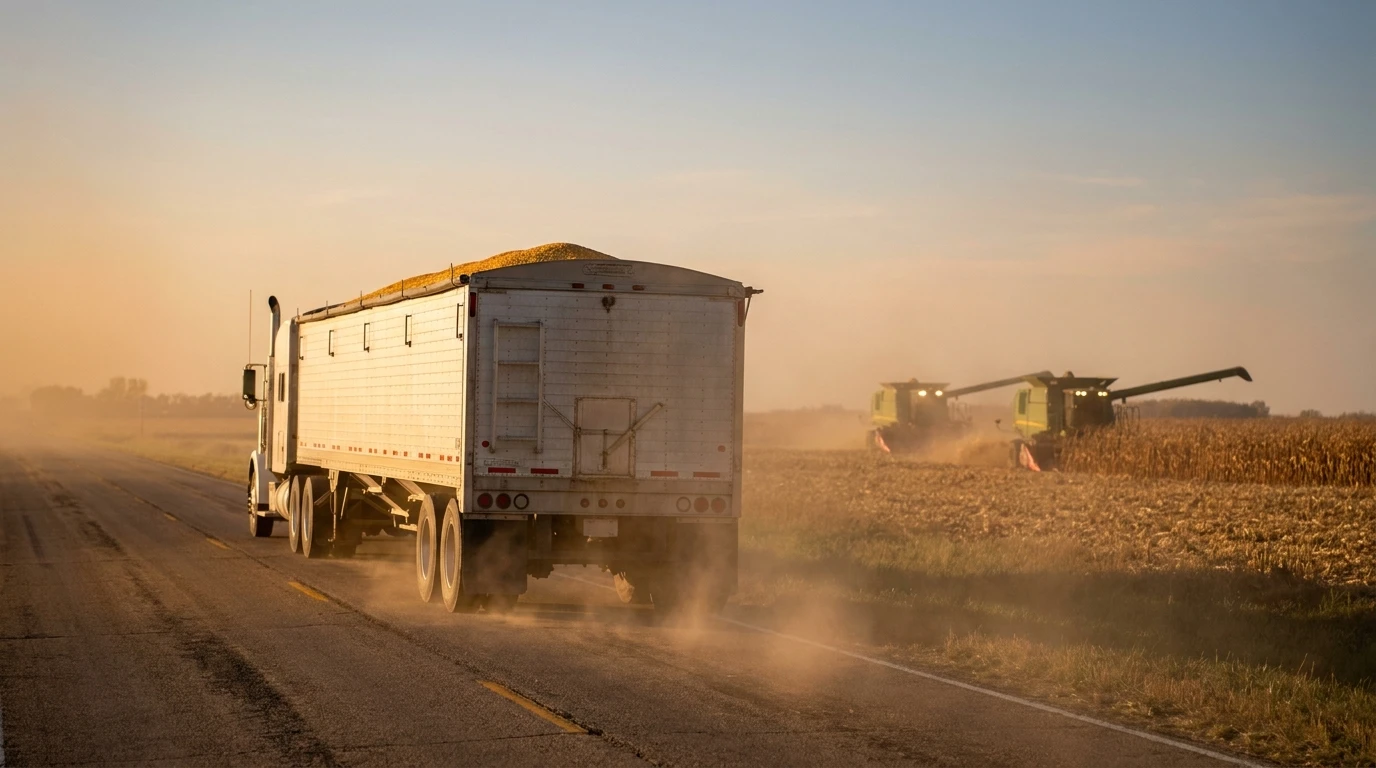
In mid-September 2026, DAT's reefer load-to-truck ratio hit 19.1, up from 9.8 the same week in 2025, as fall produce and grain harvest volumes surged against a smaller truck population (DAT, September 2026). If you haul for a farm, a grain elevator, or a custom harvesting crew, that swing is not news. It is the same window every year, compressed into a handful of weeks that decide most of the season's revenue.
That compression is exactly what scares a lender used to a steady monthly freight bill. It shouldn't. Agricultural and harvest-season hauling is a financeable business with its own calendar, a regulatory quirk most financing content ignores, and an underwriting read that looks nothing like a general freight application. Here's how that case actually works, and what to have ready before you apply for a truck.
> Key Takeaways
> - DAT's reefer load-to-truck ratio hit 19.1 at the September 2026 harvest peak, up from 9.8 the same week a year earlier (DAT, September 2026).
> - The FMCSA's 150-air-mile hours-of-service exemption during a state's declared planting and harvest season changes how many loaded miles one financed truck can run in-window (FMCSA, 49 CFR 395.1).
> - USDA forecasts 2026 net farm income at $153.4 billion, down 0.7% from 2025, the backdrop both lenders and borrowers read for ag-hauling cash flow (USDA ERS, 2026).
> - Eos Loan is a direct lender with flexible terms and no dealer fee, subject to approval and eligibility.
Ask about flexible terms on a truck purchase
What makes agricultural and harvest-season hauling different from general freight?
Agricultural hauling runs on a crop calendar, not a freight calendar. In the Pacific Northwest, onion and potato harvests begin in August and peak in September and October, generating sustained reefer demand before the Midwest grain harvest even starts (DAT, September 2026). Both compress months of potential revenue into a handful of weeks.
This post serves three buyer types: owner-operators hauling for a single farm or co-op, small carriers under contract to grain elevators, and custom harvesting businesses that follow the harvest from Texas to the Dakotas. All three share the same underwriting question: can a payment survive a business that earns most of its money in a few weeks a year?
!A grain hauling truck parked at the edge of a farm field during harvest season in daylight.
That question is distinct from the broader one. The general question of when freight-market conditions favor financing a truck covers spot-to-contract spreads, tonnage, and Class 8 order backlogs across the whole freight market. A harvest-driven hauler needs a narrower answer: how a crop calendar, not a national rate index, should shape the decision. This post stays scoped to that calendar.
> Our read: harvest is a capacity event before it is a demand event. The truck population does not grow to meet six weeks of extra freight, so the same trucks running light in July carry a season's worth of volume in September.
How tight does trucking capacity actually get during harvest?
Very tight, and predictably so. DAT's reefer load-to-truck ratio climbed to 19.1 in mid-September 2026, up from 18.2 the prior week and nearly double the 9.8 ratio recorded the same week in 2025 (DAT, September 2026). Nineteen loads competing for every available truck is not a normal week. It is the harvest window doing what it does every single year.
The reason is capacity, not just demand. Reefer truck posts ran 24% below a year earlier while load posts ran 48% above during that same September 2026 peak (DAT, September 2026). Fewer trucks met a much bigger pile of freight at once, which is the sharper point competing content usually misses when it stops at "harvest is busy."
Grain tells a similar story at the rate level, though a noisier one. USDA's Grain Truck and Ocean Rate Advisory put the average truck rate at $6.18 per loaded mile for the second quarter of 2026, with state-level rates moving in opposite directions: Kansas held roughly flat while North Dakota fell 19% year over year (USDA AMS, 2026). Local basis and harvest timing drive that number more than any national average does.
For a financing decision, the takeaway is practical: a truck you own and run yourself captures a rate spike that repeats every year at roughly the same calendar window, instead of competing for scarce hired capacity at the worst possible moment to be shopping for it.
See what financing a fleet expansion could look like
What regulatory quirk affects how much a financed truck can actually haul?
Drivers hauling agricultural commodities and farm supplies during a state's own declared planting and harvest season qualify for a 150-air-mile hours-of-service exemption from the source of the commodity to its destination (FMCSA, 49 CFR 395.1). Almost nobody financing a truck for ag hauling walks in already knowing this, and almost no financing content explains why it matters to the deal.
Here's the mechanism. Within that 150-air-mile radius, and inside a state's own defined season, the standard hours-of-service clock does not apply the way it does on general freight. In practice, that means one truck and one driver can log more loaded miles in a harvest week than the same truck would running outside that window. More loaded miles in-window is more of the revenue a lender can actually underwrite, which is exactly why a regulatory footnote belongs in a financing conversation at all.
Two boundaries matter. The exemption is state-defined: each state sets its own planting and harvest dates, so a hauler crossing state lines should confirm current dates rather than assume last year's calendar applies. It is also commodity-specific, covering agricultural commodities, livestock, and farm supplies, not general freight sharing a truck with a grain load. None of this is regulatory or legal advice; it is a reason to ask the right question before you buy the truck, not after.
Why does a tight farm economy change how you should finance the truck?
USDA's Economic Research Service forecasts 2026 net farm income at $153.4 billion, a 0.7% decline from 2025, with total farm cash receipts projected to fall 2.7% to $514.7 billion (USDA ERS, 2026). A hauler's actual customers, the farms and co-ops paying the freight bill, are managing a tighter margin year of their own.
What does that mean for the truck payment? Elevators and co-ops under their own cost pressure are not the place to absorb a payment shock passed down the chain. The truck payment has to be sized to what the hauling business earns in a realistic season, with a reserve carried through the off months, not sized to the best harvest on record.
> From the underwriting side: a harvest-driven income statement reads differently than a steady-freight carrier's, and it should. We look for the multi-year pattern, the same elevator contracts, the same co-op relationships, the same acres served season after season, rather than penalizing the off-season gap on its face. A thin spring on the bank statement is not automatically a red flag if the harvest months behind it tell a consistent story.
This is where structure matters more than rate shopping. A payment the business can carry through a slow spring beats a marginally lower number that quietly assumes every harvest repeats the best one. This is general cash-flow reasoning, not tax guidance and not a claim that Eos Loan sizes payments around harvest timing as a special feature.
How should you structure financing for a seasonal hauling business?
Structure is the part of this decision the borrower controls, regardless of which way the farm economy or the harvest calendar moves in a given year. Four pieces of that structure carry more weight than any single rate quote.
Size the payment to a typical harvest, not the best one on record. A plan built on last year's exceptional yield sets the payment up to fail the first time weather or prices return to normal. Carry a reserve through the off-season instead of spending it down on the truck, since repair and fuel costs don't pause between harvests.
Equipment type matters more than buyers expect: a grain or silage trailer financed as a vocational truck is a different conversation than a day cab for short elevator runs or a sleeper for regional hauling. See vocational truck financing for dump, tow, and mixer equipment and day cab versus sleeper truck financing for how those choices change the deal. New versus used is its own decision; see used versus new truck financing. Down payment size affects the cushion a business carries into a slow month; see semi-truck down payment options.
!An owner-operator reviewing paperwork on a laptop inside a bright truck cab in daylight.
Know who holds the paper, too. Eos Loan is a direct lender, one team from application through funding, not a broker and not a marketplace passing a file between unknown buyers. For the full mechanics of payment sizing and lender evaluation beyond the harvest-specific pieces covered here, the pillar walks through how truck fleet financing works for owner-operators and carriers end to end.
Eos Loan charges no dealer fee, stated plainly. Terms on truck fleet financing are flexible and sized to the operation, subject to approval and eligibility; we won't quote a month count here, since that range applies only to battery energy storage financing. A grain truck sitting idle eight months a year is not automatically a bad bet. It's the same seasonality that worries a first-time borrower, and the reason the rate spike above repeats on a calendar both sides can plan a payment around.
Talk to our team about financing your next truck
Prefer to talk it through? Call +1 833-989-3737 and walk a truck purchase through with our team.
---
{ question: "How do you finance a truck for hauling grain or produce?", answer: "The same way any commercial truck gets financed: a lender evaluates the business, its freight relationships with elevators, co-ops, or packers, and how the payment fits the hauling business's seasonal cash flow rather than a smoothed monthly average. Subject to approval and eligibility." }, { question: "Does farming-related hauling count as a business for truck financing?", answer: "Yes. A carrier, owner-operator, or custom harvesting business hauling agricultural commodities is evaluated as a commercial hauling business, not differently just because its freight is seasonal rather than spread evenly across the year." }, { question: "Why does trucking capacity get so tight during harvest?", answer: "Harvest compresses months of freight into a few weeks while the truck population stays roughly fixed. DAT's reefer load-to-truck ratio hit 19.1 in mid-September 2026, nearly double the 9.8 ratio the same week a year earlier (DAT, September 2026)." }, { question: "Can I get a truck loan if my income is seasonal?", answer: "Seasonal revenue isn't disqualifying. What matters is whether the pattern repeats, the same contracts, elevators, or acreage served year over year, and whether the payment is sized to a typical season with a reserve for the off months. Subject to approval and eligibility." } ]} />Financing that matches the crop calendar
Harvest doesn't surprise anyone who has hauled through one before. It tightens capacity on a calendar you can set a watch by, it comes with a regulatory detail that changes how much a financed truck can actually move in-window, and it lands in a year when the farm economy leaves less room for a payment shock to travel down the chain.
- Capacity tightens predictably every harvest; DAT's reefer load-to-truck ratio hit 19.1 at the September 2026 peak, nearly double a year earlier.
- The FMCSA's 150-air-mile exemption during a state-declared harvest season changes how much one financed truck can haul, within state-defined and commodity-specific limits.
- A softer farm income year makes payment sizing, not rate shopping, the structural decision that protects the business.
None of that changes what you control: size the payment to a real season, keep the reserve, and pick the right equipment for the job. When those pieces line up, financing for trucks and fleet expansion is a conversation, not a form.
---
About the author: Eduardo Donadi is the CEO of Eos Loan, a US direct lender financing essential projects including truck fleet expansion, battery energy storage, EV chargers, and water filtration. He works directly with carriers, owner-operators, and distributors on how equipment purchases get structured and funded.
---
Sources
1. DAT Freight and Analytics. "Reefer Report: Peak Fall Produce Season Boosts Reefer Demand." September 2026. Retrieved 2026-10-01. https://www.dat.com/blog/reefer-report-peak-fall-produce-season-boosts-reefer-demand
2. USDA Agricultural Marketing Service. "Grain Truck and Ocean Rate Advisory, 2nd Quarter 2026." 2026. Retrieved 2026-10-01. https://www.ams.usda.gov/sites/default/files/media/GTOR2ndQtr2026.pdf
3. Federal Motor Carrier Safety Administration. "Agricultural Exemptions, 49 CFR 395.1." Current rule, effective 2013. Retrieved 2026-10-01. https://www.fmcsa.dot.gov/sites/fmcsa.dot.gov/files/docs/regulations/hours-service/405336/ag-powerpoint-presentation-final.pdf
4. USDA Economic Research Service. "Highlights from the Farm Income Forecast." 2026. Retrieved 2026-10-01. https://www.ers.usda.gov/topics/farm-economy/farm-sector-income-finances/highlights-from-the-farm-income-forecast