

Battery Storage Warranties and Financing: What's Covered Over a 20-Year System Life
Most home battery storage warranties run 10 years and guarantee at least 70% capacity retention by the end of that period (EnergySage, 2026). Few homeowners read that document closely, and the financing conversation usually happens somewhere else entirely, even though a loan can outlast the warranty by a decade.
That gap matters. Battery energy storage financing can run 6 to 240 months, while a system's useful life often extends 15 to 20 years (NREL Annual Technology Baseline, 2024). This article explains what a battery storage warranty actually covers, how terms compare across common structures, and how to think about warranty coverage against a financing term without treating either document as an afterthought.
> Key Takeaways
> - Most battery storage warranties run 10 years and guarantee 70-80% capacity retention by year 10 (EnergySage, 2026).
> - Warranties are structured around three limits: years, charge cycles, and energy throughput, whichever comes first.
> - NREL's Annual Technology Baseline assumes a 15-year system lifetime, longer than most warranty periods (NREL ATB, 2024).
> - Financing terms (6-240 months at Eos Loan) and manufacturer warranty terms are separate agreements that don't need to match.
See how Eos Loan financing helps you close more projects
What Does a Battery Storage Warranty Typically Cover?
A standard battery storage warranty covers manufacturing defects and guarantees a minimum capacity retention level, most commonly 70% of original capacity, for a set number of years, a set number of charge cycles, or a set energy throughput, whichever limit arrives first (EnergySage, 2026). That three-part structure is the piece most homeowners never see spelled out.
Here's how each limit works in plain terms:
- Years of coverage: A calendar clock, typically 10 years from installation.
- Total charge cycles: A full charge-and-discharge cycle counted against a cap, often in the thousands.
- Total energy throughput: The cumulative energy (measured in megawatt-hours) the battery has processed over its life.
- EnergySage, Battery Storage Warranties: What You Need to Know, retrieved 2026-08-12, https://www.energysage.com/energy-storage/battery-warranties-overview/
- NREL, Annual Technology Baseline, Residential Battery Storage, 2024, retrieved 2026-08-12, https://atb.nrel.gov/electricity/2024/residential_battery_storage
- Tesla, Powerwall Limited Warranty, accessed 2026-08-12, https://energylibrary.tesla.com/docs/Public/EnergyStorage/Powerwall/General/Warranty/en-us/Powerwall-Warranty-EN.pdf
- Wood Mackenzie, US Energy Storage Monitor, 2025, https://www.woodmac.com/
- IRS, Residential Clean Energy Credit, retrieved 2026-08-12, https://www.irs.gov/credits-deductions/residential-clean-energy-credit
- Eos Loan, product data, 2026
"Capacity retention" is the metric that ties those limits together. It's simply how much usable storage remains compared to day one. A battery isn't expected to hold 100% of its original capacity forever, and that's normal for lithium-ion chemistry. What the warranty guarantees is a floor: the battery won't drop below a stated percentage before the coverage limit is reached.
Warranty terms vary meaningfully by manufacturer. This section describes the general structure, not any single brand's specific numbers, because the details genuinely differ from one battery to the next.
Citation capsule: A battery storage warranty is typically structured around three limits, years, charge cycles, and energy throughput, whichever is reached first, alongside a minimum capacity retention guarantee. Industry-standard warranties guarantee 70-80% capacity retention after 10 years of operation (EnergySage, 2026), giving homeowners a concrete floor to check against any manufacturer's specific document.
For a full breakdown of how the loan side of this equation works, see how battery storage loan term length works.
How Long Do Battery Storage Warranties Usually Last?
Most home battery warranties run 10 years, though some manufacturers offer extensions to 12 or 15 years (EnergySage, 2026; exact terms vary by manufacturer documentation). That 10-year figure shows up so consistently across the industry that it functions as a de facto standard, even though it isn't a regulatory requirement.
Two publicly documented examples illustrate the range. Tesla's published warranty states a 10-year term with unlimited cycles and a minimum capacity guarantee for its Powerwall product (Tesla Powerwall Limited Warranty, accessed 2026). Enphase publishes a standard 10-year warranty with an optional extension to 15 years, per its current published documentation. These are cited for illustration only, not as a recommendation of either brand, and installers should always confirm the exact terms in the manufacturer's current warranty document rather than assume a number.
A common structure example: "10 years, 4,000 cycles, or 37 MWh throughput, whichever comes first, with a minimum 70% capacity retention" (EnergySage, 2026). Numbers like these are exactly what an installer or homeowner should look for on any brand's warranty page.
Warranty length is also becoming a competitive selling point as adoption grows; see the 2026 US battery storage market outlook for installers for the demand trends shaping which coverage tiers customers ask about.
Citation capsule: Most battery storage warranties carry a standard 10-year term, with some manufacturers offering optional extensions to 12 or 15 years. Tesla's published Powerwall warranty documents a 10-year term with unlimited cycles (Tesla, accessed 2026), and Enphase publishes a 10-year standard with a 15-year extension option, illustrating the range buyers should expect to compare.
What Is a Battery Degradation Warranty, and What Does the Capacity Percentage Mean?
A degradation warranty guarantees that the battery will retain a minimum percentage of its original usable capacity, commonly 70%, by the end of the warranty period. It protects against the battery losing storage ability faster than expected. It's a different promise than a defect-only warranty, which only covers the battery failing outright.
Every lithium-ion battery loses some capacity over time through ordinary charge and discharge cycling. That's chemistry, not a flaw. What a degradation warranty does is put a number on how much loss is acceptable. If a battery is rated for 13.5 kWh, a 70% capacity floor means it should still deliver roughly 9.5 kWh of usable storage at the end of the warranty period, not a total collapse in performance.
Reliable manufacturers guarantee 70-80% retention after 10 years (EnergySage, 2026), and that capacity-retention figure is the single most useful number to ask about when comparing brands. Isn't that a more concrete question than "how long is the warranty?" It gets at what the customer actually experiences: how much storage they'll still have a decade in.
Citation capsule: A battery degradation warranty guarantees a minimum retained capacity, commonly 70% of original rating, distinct from a defect-only warranty. Lithium-ion home battery systems generally last 10-15 years with manageable performance degradation when these guarantees are honored (EnergySage, 2026), making the capacity-retention percentage the clearest comparison point across brands.
How Does a Battery's Useful Life Compare to Its Warranty Period?
A battery's useful life often extends well beyond its warranty period. NREL's residential battery storage cost and performance projections use a 15-year assumed system lifetime for planning purposes (NREL Annual Technology Baseline, 2024), while many warranties run 10 years. In other words, the equipment is commonly expected to keep functioning for years after warranty coverage technically ends.
Warranty period and useful life answer two different questions. The warranty is a guarantee: the manufacturer promises a minimum capacity through a defined window. Useful life is an expectation: how long the equipment is generally expected to perform usefully, warranty or not. Industry benchmarks sometimes describe end-of-life around 60% capacity, a lower bar than the 70% warranty floor, which means a battery can keep doing meaningful work well after its warranty guarantee period closes.
Citation capsule: Warranty period and useful life are different measures. NREL's Annual Technology Baseline assumes a 15-year lifetime for residential battery storage in its cost and performance modeling (NREL ATB, 2024), while most warranties guarantee coverage for around 10 years, meaning batteries are generally expected to keep working well after the warranty guarantee window closes.
Does My Financing Term Need to Match My Battery's Warranty Length?
No. The financing term and the warranty term are two separate agreements that don't need to match, but understanding the gap between them matters for planning. Battery storage financing at Eos Loan runs 6 to 240 months, while a typical warranty runs around 10 years (Eos Loan product data, 2026; EnergySage, 2026).
A longer financing term, say 240 months (20 years), can extend past the standard 10-year warranty window. That's not inherently a problem. Many batteries continue functioning well past their warranty period, as the useful-life data above shows, and Eos Loan charges no prepayment penalty, so a borrower can pay down the loan faster if they want to close that gap sooner rather than later.
The practical takeaway for installers: walk customers through both timelines side by side at the proposal stage, not as a hidden detail buried in the fine print. The same honest framing already applies to how APR, term length, and monthly payment interact: naming the trade-off plainly builds trust, and it's never a reason to avoid a longer term when the monthly payment is what makes the project possible.
Add financing to your installs, talk to our team
Citation capsule: A battery's financing term and its manufacturer warranty term are separate agreements that don't need to align. Eos Loan offers battery storage financing terms from 6 to 240 months (Eos Loan product data, 2026), which can extend beyond a standard 10-year warranty, a planning consideration rather than a barrier, especially with no prepayment penalty on the loan.
What Happens If a Battery Needs Service or Replacement Before the Loan Is Paid Off?
If a battery fails within its warranty period, the manufacturer's warranty terms determine repair or replacement, separate from the financing agreement. The loan itself continues regardless of equipment status unless the borrower pays it off early. That distinction surprises some customers, so it's worth stating plainly up front.
The practical sequence looks like this: the homeowner files a warranty claim with the manufacturer or installer, loan payments continue as scheduled during that process, and if the borrower wants to close out the remaining balance after a battery is serviced or replaced, Eos Loan's no-prepayment-penalty structure lets them do that without a fee.
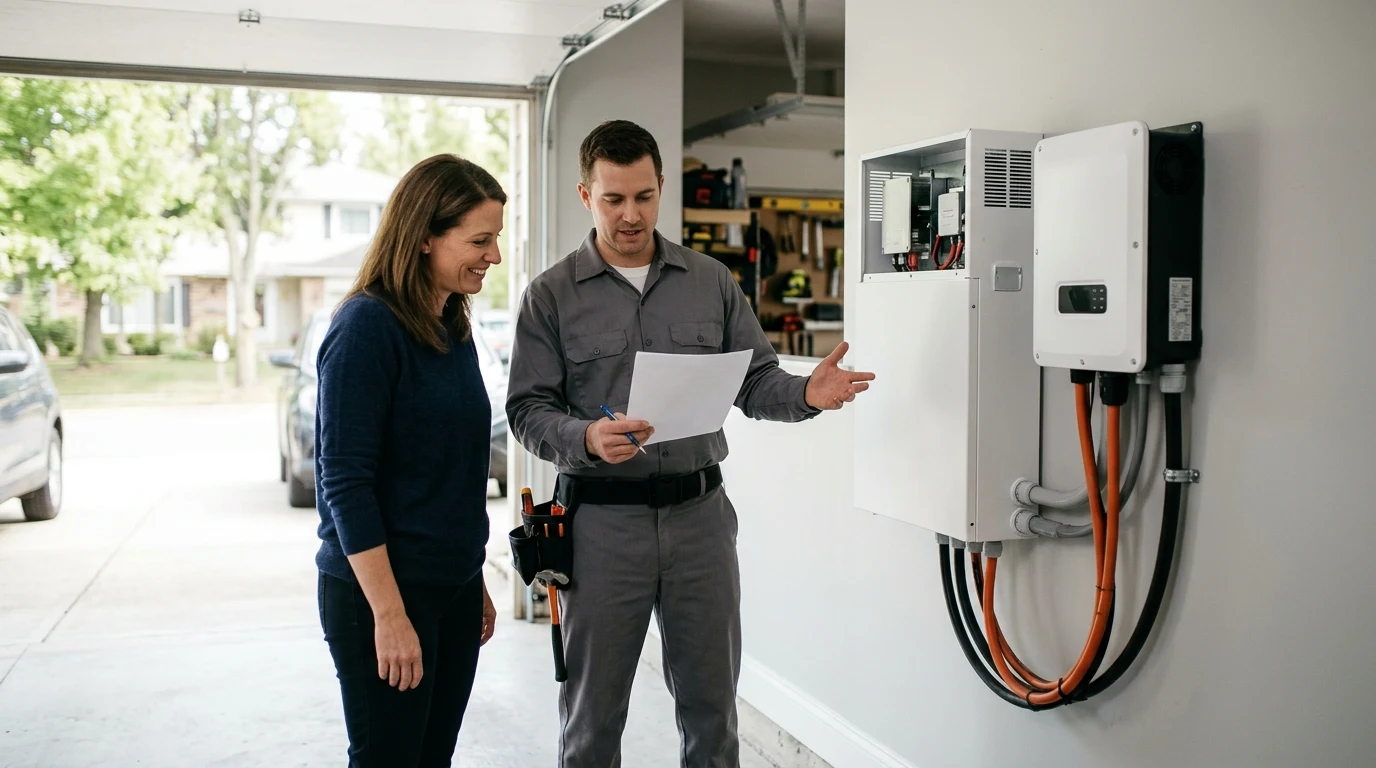
!Installer performing a service check on a wall-mounted battery storage unit in daylight
Setting this expectation clearly at signing avoids a confused or frustrated customer years later who assumed a warranty claim would somehow pause their payments. It won't, and saying so upfront is part of doing the sale right. For the full mechanics of how battery storage financing works from application to close, see how battery storage financing works end to end.
Citation capsule: A battery warranty claim and the financing agreement are legally distinct: repair or replacement is handled through the manufacturer or installer, while loan payments continue on schedule regardless of equipment status. Borrowers financing through Eos Loan can pay down or pay off the remaining balance early with no prepayment penalty (Eos Loan product data, 2026).
How Should Installers Explain Warranty and Financing Together at the Point of Sale?
Installers close more confidently when they present the manufacturer's warranty and the financing terms as two related but separate topics in the same conversation, rather than letting the customer discover the gap later. That's a small script change with a real trust payoff.
> "The warranty and the loan are two separate documents with two separate clocks. A good installer explains both clearly instead of hoping the customer never asks." - Eduardo Donadi, CEO, Eos Loan
The practical version of that script: show the specific warranty document, years, cycles, capacity guarantee, alongside the financing term options, 6 to 240 months. Naming both clocks in the same breath, rather than treating them as separate appointments, is what builds the trust that reduces post-sale service calls driven by confusion rather than actual equipment failure.
That same warranty paperwork does double duty later: a saved copy is also part of what a future appraiser looks for when a home sells with a financed battery storage system still in place.
Across the battery proposals Eos Loan sees from installer partners, the brands with longer published warranty options, Enphase's 15-year extension and similar tiers from other manufacturers, correlate with customers more comfortable choosing longer financing terms. It's a pattern worth watching, not a guarantee, but it lines up with the intuition that a longer warranty makes a longer loan term feel less risky to the customer.
Eos Loan's no-prepayment-penalty policy is a useful tool to mention in this exact conversation: a customer nervous about a 240-month commitment can hear that they're free to pay it down faster whenever they choose. For more on how this kind of transparency builds close rates, see building trust with clear financing conversations.
Become an Eos Loan financing partner
Or call +1 833-989-3737 to talk through a financing program for your business.
---
Most battery storage warranties run 10 years and guarantee roughly 70% capacity retention, structured around years, cycles, and energy throughput limits. A battery's useful life often extends beyond that period. NREL models assume a 15-year system lifetime for planning purposes, and financing terms of 6 to 240 months at Eos Loan are a separate agreement that doesn't need to match the warranty clock. Eos Loan's no-prepayment-penalty policy gives borrowers flexibility either way, and installers who explain both timelines clearly at the point of sale build the kind of trust that reduces confusion down the road.
This is general information, not financial or tax advice. Confirm specific warranty terms with the equipment manufacturer and specific loan terms at origination. Consult a qualified financial professional for guidance specific to your situation.
Frequently Asked Questions
{ question: "What does a home battery storage warranty typically cover?", answer: "Most battery storage warranties cover manufacturing defects and guarantee a minimum capacity retention level, commonly 70%, over a period defined by years, charge cycles, or energy throughput, whichever comes first (EnergySage, 2026). Exact terms vary by manufacturer; always confirm with the specific brand's current warranty document." }, { question: "How long do battery storage warranties usually last?", answer: "Most manufacturers offer a standard 10-year warranty, with some brands offering optional extensions to 12 or 15 years (EnergySage, 2026). Published examples include Tesla's Powerwall limited warranty (10 years, unlimited cycles) and Enphase's standard 10-year term with an optional 15-year extension, per each manufacturer's published documentation." }, { question: "What is a battery degradation warranty?", answer: "A degradation warranty guarantees the battery retains a minimum percentage of its original usable capacity, commonly 70%, by the end of the warranty period. It protects against the battery losing storage capability faster than expected, distinct from a defect-only warranty. Reliable manufacturers typically guarantee 70-80% retention after 10 years (EnergySage, 2026)." }, { question: "Does my battery financing term need to match the warranty length?", answer: "No. The financing term and the manufacturer's warranty are separate agreements. Eos Loan offers battery storage financing terms from 6 to 240 months (Eos Loan product data, 2026), which can extend beyond a standard 10-year warranty. That's a planning consideration, not a barrier, especially since Eos Loan charges no prepayment penalty. Financing subject to approval and eligibility." }, { question: "What happens if my battery needs replacement before my loan is paid off?", answer: "A warranty claim and repair or replacement are handled through the manufacturer or installer and don't change the financing agreement; loan payments continue on schedule regardless of equipment status. Borrowers can also choose to pay down or pay off the remaining balance early with no prepayment penalty. Confirm specific terms at origination." } ]} /> --- Sources