

Battery Storage Financing Before Hurricane Season
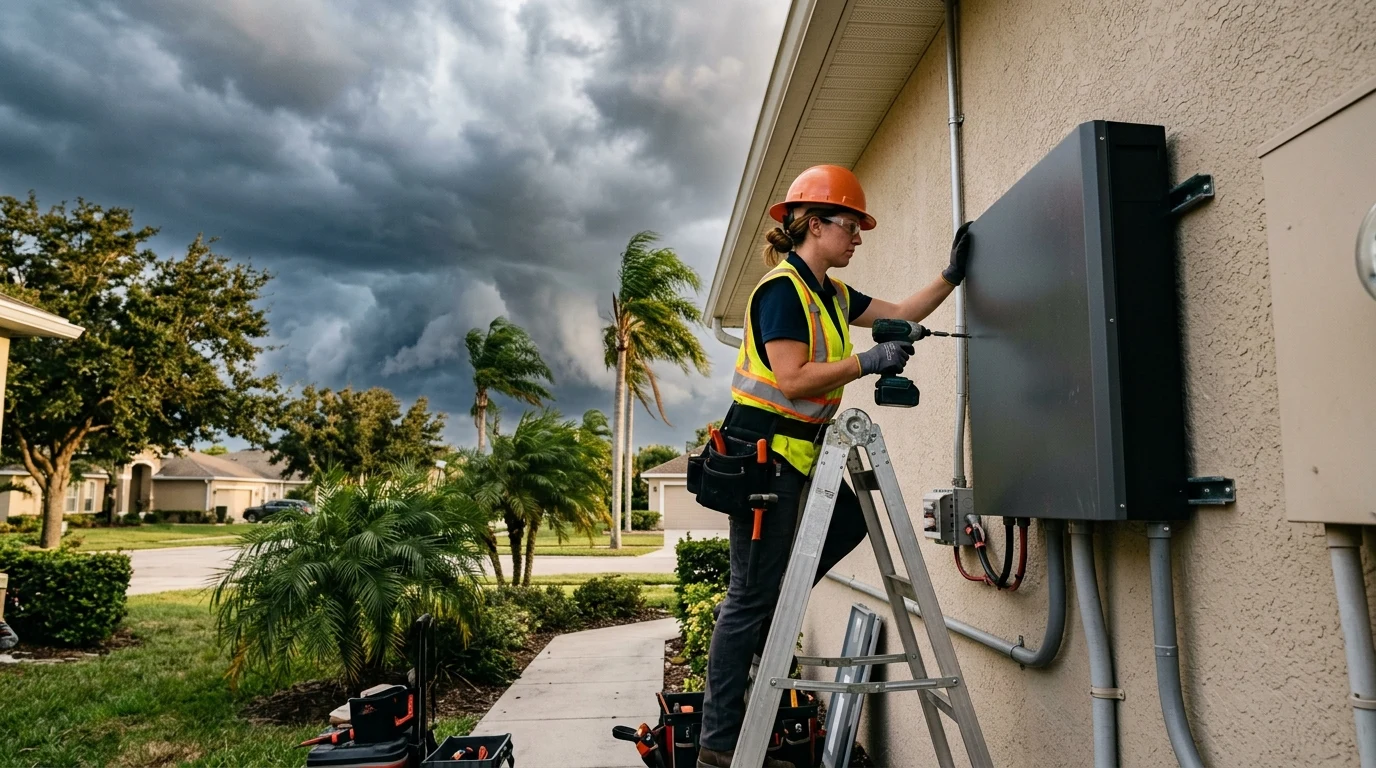
A hurricane watch gives homeowners about 48 hours' notice before tropical-storm-force winds arrive (National Hurricane Center). A battery storage install takes 60-90 days from signed contract to full activation (EnergySage, 2026). Installers who wait for storm season to start marketing financing are already too late for the customers who wait for a named storm to act.
This piece walks through the 2026 season calendar, the real install-timeline math, which states carry the most pre-season pressure, and a checklist for building financing readiness before the first watch is issued.
> Key Takeaways
> - Battery storage installs average 60-90 days from contract to activation, but a hurricane watch gives only 48 hours' notice, and a warning gives 36 (EnergySage, 2026; NHC).
> - NOAA's 2026 Atlantic season runs June 1 through November 30, forecasting 8-14 named storms, 3-6 hurricanes, and 1-3 major hurricanes (NOAA, 2026).
> - Florida non-renewed 3.35% of homeowners policies in 2024, 1.7x its 2018 rate, a sign of rising storm-risk pricing across the Gulf and Atlantic coast (Insurify, 2025).
> - Storage installations set a record in 2025, up 52% year over year, even as the federal tax credit expired, evidence that financing, not the credit, now closes the deal (Wood Mackenzie/ACP, 2025).
See how Eos Loan financing helps you close more projects
When does the 2026 Atlantic hurricane season start, and why does the date matter?
The 2026 Atlantic hurricane season runs June 1 through November 30. NOAA forecasts 8-14 named storms, 3-6 hurricanes, and 1-3 major hurricanes this year, a slightly below-normal-leaning outlook overall (NOAA, 2026). A below-normal-leaning forecast still means storms will form. It just shifts the odds, not the outcome for any single property.
That six-month window matters less as a weather forecast and more as a scheduling deadline. Every day of it, a customer somewhere is deciding whether to finance a battery storage project now or wait. If an installer's financing partner isn't ready before June 1, the busiest sales weeks of the year arrive with no capacity behind them. Therefore, National Hurricane Preparedness Week, which falls May 3-9, 2026, is the practical marker to have financing marketing live by (FEMA/NOAA, 2026).
However, a below-normal-leaning outlook can also work against installers who don't plan ahead. A quieter forecast tends to soften urgency in marketing copy and in sales conversations. That relaxed tone holds right up until the first storm forms, and then the outlook stops mattering to anyone watching the news. In fact, NOAA's own outlooks carry meaningful uncertainty this far out, and even a below-normal season has produced destructive landfalling storms in past years. Therefore, treating the forecast as a floor, not a ceiling, keeps financing-readiness planning from sliding into summer.
!An installer reviewing an install schedule on a tablet in a bright warehouse in daylight
Most hurricane-season content treats the season start date as a weather milestone. For a financing-capacity plan, it's better read as a countdown. Work backward from June 1 using the install timeline below, and the real deadline for having financing capacity in place lands closer to March or April, not the season's opening week.
How long does it actually take to install battery storage?
A typical solar-plus-storage project takes 60-90 days from signed contract to full activation (EnergySage, 2026). Adding battery storage extends the permission-to-operate timeline by roughly 30% versus solar alone. That span covers design, permitting, physical installation, inspection, and utility interconnection. Interconnection is usually the stage with the widest variance by utility.
Standalone battery storage without solar tends to move faster through permitting, since there's no separate PV interconnection application. However, it still isn't a same-week job once equipment lead times and electrical inspection are factored in. Compare that 60-90 day window against how little notice a storm actually gives. A hurricane watch is issued 48 hours before tropical-storm-force winds are expected, and a warning follows at 36 hours out (NHC). No installer can compress a 60-90 day process into a two-day warning window, no matter how good the crew is.
Where does that timeline actually go? Design and site assessment typically run one to two weeks. Permitting varies the most by jurisdiction, anywhere from a few days to over a month depending on the AHJ. Equipment lead time and physical installation usually take another one to two weeks once permits clear. Utility interconnection and permission-to-operate close out the process, and this stage alone can stretch four to eight weeks in utilities with a backlog. A permission-to-operate (PTO) approval is the utility's final sign-off before a system can legally be energized, and it's the single biggest source of timeline variance. Add those stages together and the 60-90 day range stops looking conservative. In fact, it's optimistic for some interconnection queues.
Add financing to your installs, talk to our team
Why does reactive, storm-triggered demand create scheduling problems?
US electricity customers averaged 11 hours of power interruptions in 2024, with hurricanes driving 80% of that total (EIA, 2025). That reliability backdrop pulls buyers toward battery storage. However, the buyers who wait until a storm is named on the news are the hardest to serve well, because their decision timeline and the install timeline don't match.
!A contractor crew loading equipment into a service van in daylight on an ordinary workday
The mismatch shows up as a scheduling bottleneck, not a sales problem. For example, a customer who calls the week a storm forms in the Atlantic can still sign a contract that week. They can't have a system energized before that storm makes landfall. For the fuller data picture on why outage-driven demand is durable rather than a one-storm spike, see why grid outages are fueling battery storage financing demand. This post focuses on the planning window before that demand arrives, not the demand data itself.
Reactive shoppers also tend to compress the sales process in ways that hurt approval odds and satisfaction later. A rushed application filled out during a storm scare is more likely to have gaps than one completed calmly weeks earlier. Consequently, installers who start the financing conversation early, well before a storm is on the radar, give customers time to get pre-qualified, compare payment options, and sign with realistic expectations about when the system will actually be live. That's a better outcome for everyone than a panicked signature two days before landfall.
Which states carry the most storm-season financing pressure?
Florida non-renewed 3.35% of homeowners policies in 2024, the highest rate in the nation and 1.7 times its 2018 rate of 1.98%, as insurers price in escalating storm risk (Insurify, based on Weiss Ratings analysis of NAIC data, 2025). A non-renewal is when an insurer declines to continue a policy at its next renewal date, distinct from a mid-term cancellation, and it's a leading indicator of geographic risk repricing. Therefore, that non-renewal trend is a useful signal for where storm-motivated storage demand concentrates: Gulf and Atlantic storm-belt states, primarily Texas, Florida, and the Carolinas.
That insurance-market pressure lines up with where storage is actually getting installed. Residential battery storage hit 1.3 GWh in the first quarter of 2026, up 86% year over year, with Texas leading deployment growth alongside California, Hawaii, and Arizona (Wood Mackenzie, 2026). Therefore, Texas sits in both categories: a top storm-exposed state and a top storage-growth state, which makes it the clearest priority market for pre-season financing capacity.
Similarly, Florida and the Carolinas follow a similar pattern, even though their growth numbers individually run smaller than Texas or California. What connects all three storm-belt markets isn't just wind risk. It's a home insurance market that's actively pushing homeowners toward self-reliance, whether through higher premiums, coverage gaps, or non-renewal. Moreover, all of that makes a financed storage system look more like a hedge against a worsening insurance market than a discretionary purchase. Installers serving these states should treat pre-season financing capacity as a baseline requirement, not a nice-to-have add-on. Senior care and assisted living operators in these same storm-belt states carry an added, life-safety-driven version of this urgency; see battery storage financing for assisted living and senior care facilities.
Why is financing, not the expired tax credit, the deciding factor now?
The residential clean-energy credit (Section 25D) ended December 31, 2025 (IRS, 2025). However, US storage installations still set a record that year, up 52% year over year (Wood Mackenzie/ACP, 2025). That gap is worth sitting with: if the credit had been the primary driver, installations should have softened once it expired. They didn't.
> What we're seeing: In our experience working with storm-belt dealer partners in Texas, Florida, and the Carolinas, we've found that financing pre-qualification activity builds steady momentum through March and April, well before June 1, rather than spiking only after a storm is named. From what we've seen, installers who make a financed-payment option visible to customers early in the year report smoother scheduling than those who scramble once the first watch is issued.
Payment structure, not the credit, is now the lever that closes deals. Financing terms for battery storage run 6 to 240 months, described as flexible and subject to approval and eligibility, whether the project is standalone storage or paired with solar. This is general information, not tax advice. Consult a qualified tax professional about how the credit's expiration applies to a specific project. Furthermore, for the full framework on selling with payments instead of incentives, see the battery storage financing guide for installers.
How can installers build a pre-season financing plan?
Line up financing capacity and marketing before NOAA's June 1 season start, ideally around National Hurricane Preparedness Week (May 3-9, 2026), not after the first storm is named. A 36-48 hour warning window can't absorb a 60-90 day install cycle, so the readiness work has to happen months earlier.
!An installer and homeowner reviewing a financing proposal on a tablet on a porch in bright daylight
A practical pre-season checklist covers four moves:
- Pre-qualify a financing partner before spring, not mid-summer.
- Build storm-belt marketing around Hurricane Preparedness Week instead of waiting for a storm headline.
- Prioritize permitting and interconnection paperwork early for storm-belt customers so the install clock starts sooner.
- Keep a standing financed-payment option visible on every proposal, not just on quotes issued after a storm scare.
- NOAA, 2026 Atlantic Hurricane Season Outlook, retrieved 2026-08-01, https://www.noaa.gov/news-release/noaa-predicts-below-normal-2026-atlantic-hurricane-season
- National Hurricane Center, Watch/Warning Issuance Criteria, retrieved 2026-08-01, https://www.nhc.noaa.gov/watchwarn_changes.shtml
- EnergySage, How Long Does It Take to Install Solar Panels (and Storage), retrieved 2026-08-01, https://www.energysage.com/solar/how-long-does-it-take-to-install-solar-panels/
- EIA, Today in Energy: outage duration data, retrieved 2026-08-01, https://www.eia.gov/todayinenergy/detail.php?id=66744
- Insurify, based on Weiss Ratings analysis of NAIC data, Florida Homeowners Insurance Crisis, retrieved 2026-08-01, https://insurify.com/homeowners-insurance/florida/florida-insurance-crisis/
- Wood Mackenzie, U.S. Energy Storage Market Sets Q1 2026 Records Across Sectors, retrieved 2026-08-01, https://www.woodmac.com/press-releases/u.s.-energy-storage-market-sets-q1-2026-records-across-sectors
- Wood Mackenzie/American Clean Power Association, 2025 U.S. Energy Storage Installations Set New Record, retrieved 2026-08-01, https://www.woodmac.com/press-releases/2025-u.s.-energy-storage-installations-set-new-record-surpass-2024-by-52
- IRS, Residential Clean Energy Credit (Section 25D), retrieved 2026-08-01, https://www.irs.gov/credits-deductions/residential-clean-energy-credit
- FEMA/NOAA, National Hurricane Preparedness Week, retrieved 2026-08-01, https://www.weather.gov/mob/AwarenessWeeks
- Eos Loan, battery energy storage financing terms (6-240 months), internal product data, retrieved 2026-08-01
Isn't the easiest fix here just carrying more inventory? Not on its own. Inventory solves the equipment side. However, without financing capacity ready at the same time, a fully stocked warehouse still can't turn interest into a signed, funded contract fast enough. Additionally, raising average ticket size matters here too, since a bundled storm-readiness package (storage plus a critical-load panel, say) needs financing that can flex with it. See raising average ticket size with contractor financing and smoothing seasonal cash flow with financing for the adjacent planning pieces.
Become an Eos Loan financing partner
Or call +1 833-989-3737 to talk through a financing program for your business.
Frequently Asked Questions
question: "When does the 2026 Atlantic hurricane season start?",
answer: "June 1, 2026, running through November 30, with NOAA forecasting 8-14 named storms, 3-6 hurricanes, and 1-3 major hurricanes this season (NOAA, 2026)."
},
{
question: "How far in advance does a hurricane watch or warning give homeowners notice?",
answer: "A hurricane watch is issued about 48 hours before tropical-storm-force winds are expected; a warning follows at roughly 36 hours out (National Hurricane Center, watch/warning issuance criteria)."
},
{
question: "How long does battery storage installation take?",
answer: "Roughly 60-90 days from signed contract to full activation for a typical solar-plus-storage project, with battery storage adding about 30% to the permission-to-operate timeline versus solar alone (EnergySage, 2026)."
},
{
question: "Is battery storage financing available for projects outside solar-plus-storage, like standalone systems?",
answer: "Yes. Financing terms for battery storage range from 6 to 240 months, described as flexible and subject to approval and eligibility, whether the system is standalone or paired with solar."
}
]} />
The takeaway on hurricane season and battery storage financing lead time
NOAA's 2026 season runs June 1 through November 30. A battery storage install still takes 60-90 days, and a hurricane watch still gives only 48 hours' notice. That gap doesn't close on its own, and it won't close after the first named storm either. Therefore, installers who line up financing capacity before the season opens are positioned to close storm-motivated deals. Those who wait for the first watch are structurally too late.
Contact Eos Loan to build a pre-season financing plan before storm-belt demand spikes.
---
Written by Eduardo Donadi, CEO of Eos Loan. Eos Loan is the fintech built to finance essential projects (battery energy storage, EV chargers, and water filtration) for installers, contractors, and resellers across the United States.
Sources