

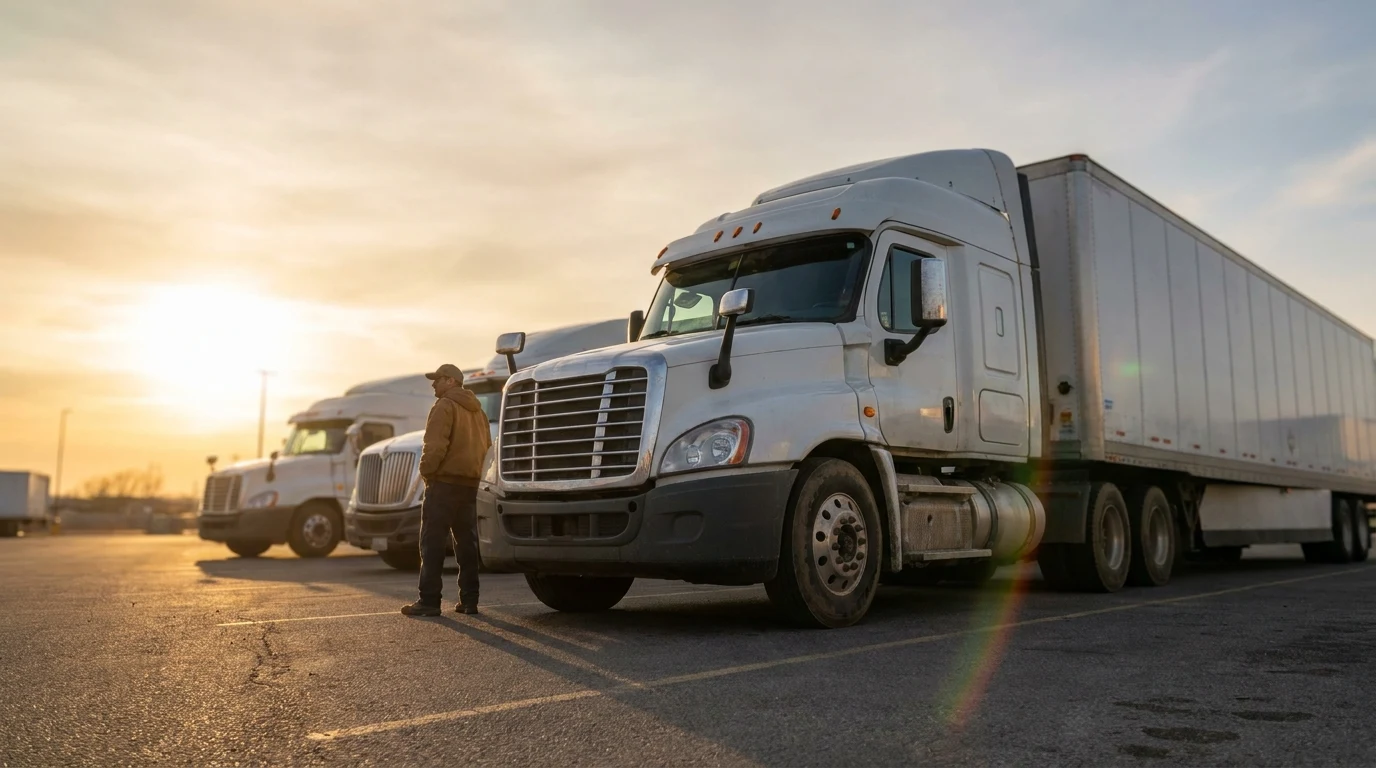
An SBA 7(a) loan can guarantee up to $5 million, but "SBA loan" and "equipment financing" aren't interchangeable tools for buying the same truck (SBA.gov). Carriers evaluating a purchase often assume the two paths are just different rates on the same product. They aren't.
The real differences sit in speed, what's actually eligible, and who holds the paper. A five-truck carrier adding a sixth unit mid-quarter can't always wait six to ten weeks for an SBA guarantee to clear. This post lays out what each path actually is, where they overlap, and the axes that matter before you sign anything.
> Key Takeaways
> - Most SBA 7(a) loans max out at $5 million, with terms up to 25 years for long-life assets (SBA.gov).
> - Most straightforward 7(a) applications take 30 to 45 days from application to funding, since a federal guarantee has to clear on top of underwriting (SBA.gov).
> - 7(a) is the SBA program actually used for vehicle purchases; 504 targets fixed assets with a 10+ year useful life, a mismatch for a depreciating truck.
> - A direct fleet lender underwrites the truck and the carrier's numbers, not a federal guarantee file, and can often move on a faster timeline.
See what financing a fleet expansion could look like
Is an SBA loan the same thing as equipment financing?
No. SBA backing is a federal guarantee attached to a loan a private lender makes. It describes who absorbs the risk if the borrower defaults, not a specific product built for buying a truck. Most 7(a) loans max out at $5 million, and the SBA guarantees up to 85% of loans of $150,000 or less and up to 75% above that (SBA.gov).
"SBA loan" actually covers two different programs. The 7(a) program is general-purpose: working capital, equipment, and vehicles all qualify. The 504 program is built for major fixed assets, think owner-occupied real estate or heavy manufacturing equipment, financed through a bank loan and a separate debenture from a Certified Development Company (SBA.gov). A direct equipment lender's own-capital loan skips that federal layer entirely. The lender funds from its own balance sheet, underwrites the deal itself, and services the loan itself.
!A row of Class 8 sleeper tractors parked side by side in a carrier yard under daylight.
That distinction matters because it changes who you're actually negotiating with. With an SBA-guaranteed loan, you're working with a private lender whose decision still has to satisfy federal eligibility rules. With a direct lender, the underwriting and the funding sit with one team, and Eos Loan is a direct lender, never a broker or marketplace arranging someone else's guarantee.
Can you actually use an SBA loan to buy a semi truck?
Yes, through 7(a), but 504 is a poor fit. 504 financing targets fixed assets with a useful life of 10+ years, and most commercial trucks don't meet that bar once depreciation and mileage are factored in. SBA loan terms can extend up to 10 years generally, or up to 25 years only for real estate or equipment with a useful life exceeding 10 years (SBA.gov).
Most SBA-versus-equipment-financing content online treats "SBA loan" as one undifferentiated product and skips this useful-life detail entirely. It's the gap that actually matters for a truck purchase specifically, since the 504 structure was designed around assets that outlast a mortgage-style amortization, not a tractor that will log hundreds of thousands of miles.
7(a) eligibility runs through standard small-business tests: the business has to be for-profit, meet SBA size standards for its industry, and operate primarily in the United States. A carrier or distributor that clears those tests can use 7(a) proceeds for a truck purchase, working capital, or both in the same loan, which is one reason some larger capital plans still reach for it despite the slower runway.
How long does each path actually take to fund?
Most straightforward SBA 7(a) applications take 30 to 45 days from application to funding (SBA.gov). A direct lender underwriting the truck and the carrier's own numbers can often move faster, because there's no federal guaranty review layered on top of the lender's own underwriting.
The SBA timeline runs through several stages that each add days: documentation and application assembly, the lender's own credit underwriting, and then a separate SBA guaranty review before funds move. None of those stages is optional, and a file with incomplete records restarts the clock rather than skipping ahead.
A direct lender's process collapses some of those steps because there's one underwriting pass, not two. For a carrier that needs a replacement truck now, not in six weeks, that difference in timeline can matter more than the headline terms on either loan.
Ask about flexible terms on a truck purchase
What does each lender actually underwrite?
SBA-guaranteed loans lean on a documented small-business qualification file and a federal guarantee sitting behind the private lender's own review. A direct fleet lender underwrites the truck itself as collateral, plus the carrier's operating numbers, most importantly revenue per mile against cost per mile.
The paperwork load differs accordingly. An SBA file typically includes size-standard documentation, personal guarantees from owners with a significant stake in the business, and forms specific to the guaranty program. A direct lender's file centers on the equipment being financed (model year, mileage, spec, maintenance history), the carrier's authority and insurance status, time in business, and cash flow.
That operating-numbers question isn't abstract. In 2025, average trucking operating cost hit a record $2.336 per mile, with non-fuel costs at $1.854 per mile (ATRI, July 2026). This is the figure a direct lender is underwriting against when it sizes a truck payment: does the margin on the lanes this truck will run actually cover the payment, inside a cost structure that's already tight.
Most comparison content treats this as a rate question. It rarely is. The real driver is what each lender is reading when it decides: a guaranty eligibility file on one side, a cost-per-mile operating picture on the other. Knowing which file you're actually building changes what you prepare before you apply.
SBA loan vs a direct fleet lender
| Axis | SBA 7(a)/504 loan | Direct fleet/equipment lender |
|---|---|---|
| Program type | Federal guarantee behind a private lender's own loan | Direct capital, lender's own balance sheet |
| Typical loan maximum | $5M per program; up to $10M combined 7(a)/504 | Sized to the equipment and the deal |
| Typical term length | Up to 10 years generally, up to 25 years for 10+ year-life assets | Flexible terms, sized to the truck and operation |
| Typical time to funding | 30-45 days for a straightforward 7(a) file | Often faster, no federal guaranty layer to clear |
| Collateral basis | Business qualification file, personal guarantee, asset securing the loan | The truck itself, plus the carrier's operating numbers |
| Who services the loan | The private lender, under SBA program rules | The direct lender, start to finish |
| Best-fit asset type | Longer-horizon capital plans; 504 fits 10+ year fixed assets, not vehicles | A depreciating vehicle purchase specifically |
As of July 2026, SBA borrowers can combine 7(a) and 504 loans for up to $10 million in combined SBA-backed financing, up from a previous $5 million cumulative limit (SBA.gov). That higher ceiling matters for a carrier planning a larger, multi-asset expansion, but it doesn't change the funding timeline or the 504 useful-life mismatch for a single truck purchase.
Which path fits your next truck purchase?
If the purchase is time-sensitive, or the truck itself is the primary asset a lender should be underwriting, a direct equipment or fleet lender is usually the faster fit. An SBA-guaranteed loan can make sense as part of a larger, longer-horizon capital package, real estate plus equipment plus working capital, but it carries a longer runway to funding and more qualification paperwork along the way.
Weigh four things before you choose: how urgent the purchase is, how large the total deal is, whether the truck is the only asset involved or one piece of a bigger expansion, and how comfortable you are with SBA-style personal guarantees and documentation. None of those answers is universally right; they depend on your freight, your timeline, and your balance sheet.
!A Class 8 tractor pulling out of a carrier yard onto a highway in golden-hour daylight.
Eos Loan is a direct lender, not a broker or marketplace, and we don't arrange or imply an SBA-guaranteed product. What we offer is flexible terms sized to the truck and the operation, subject to approval and eligibility, with one team from application to funding. For background on how that underwriting works more broadly, see how truck fleet financing works, and if credit history is the open question on your file, what carriers need to qualify for financing covers that separately.
Talk to our team about financing your next truck
Prefer to talk it through? Call +1 833-989-3737.
---
Frequently Asked Questions
Can you use an SBA loan to buy a semi truck?
Yes, generally through the 7(a) program. The 504 program is structured for fixed assets with a 10+ year useful life, which doesn't fit most trucks once depreciation and mileage are accounted for (SBA.gov).
How long does an SBA loan take to fund?
Most straightforward 7(a) applications take 30 to 45 days from application to funding, since the process adds a federal guaranty review on top of the lender's own underwriting (SBA.gov). More complex files can take longer.
What's the maximum SBA loan amount for a fleet purchase?
Most individual 7(a) loans max out at $5 million. As of mid-2026, 7(a) and 504 financing can be combined for up to $10 million in total SBA-backed financing (SBA.gov).
Is a direct equipment lender better than an SBA loan?
Neither is universally better. A direct lender underwrites the truck and the carrier's numbers and can often move faster, while an SBA-guaranteed loan may fit a larger, longer-horizon capital need. Eos Loan is a direct lender, not a broker or marketplace, and does not arrange SBA-guaranteed credit.
Do you need a down payment for either option?
Down payment and collateral requirements vary by lender and program. Eos Loan's terms are flexible, subject to approval and eligibility, and we don't quote a specific rate or percentage as our own. For more on how a down payment factors into a truck purchase generally, see down payment options on a truck purchase, or using a trade-in as collateral if you're offsetting one.
---
The short version
An SBA loan and a direct fleet loan solve different problems, and the choice isn't really about headline rate.
- SBA backing is a federal guarantee structure, not a truck-buying product on its own.
- 7(a) fits vehicles; 504 targets assets with a 10+ year useful life, a mismatch for a depreciating truck.
- Funding speed differs by weeks, not days: 30 to 45 days is typical for a straightforward 7(a) file.
- A direct lender underwrites the truck and the carrier's cost-per-mile numbers, not a federal guaranty file.
- The combined SBA borrowing ceiling just doubled to $10 million, which matters more for larger, multi-asset plans than for a single truck.
If the purchase can't wait on a federal guaranty to clear, Eos Loan's truck fleet financing is worth a conversation before the SBA paperwork goes in.
---
About the author: Eduardo Donadi is the CEO of Eos Loan, a US direct lender financing essential projects including truck fleet expansion, battery energy storage, EV chargers, and water filtration. He works directly with carriers, owner-operators, and distributors on how equipment purchases get structured and funded.
---
question: "Can you use an SBA loan to buy a semi truck?",
answer: "Yes, generally through the 7(a) program. The 504 program is structured for fixed assets with a 10+ year useful life, which doesn't fit most trucks once depreciation and mileage are accounted for (SBA.gov)."
},
{
question: "How long does an SBA loan take to fund?",
answer: "Most straightforward 7(a) applications take 30 to 45 days from application to funding, since the process adds a federal guaranty review on top of the lender's own underwriting (SBA.gov). More complex files can take longer."
},
{
question: "What's the maximum SBA loan amount for a fleet purchase?",
answer: "Most individual 7(a) loans max out at $5 million. As of mid-2026, 7(a) and 504 financing can be combined for up to $10 million in total SBA-backed financing (SBA.gov)."
},
{
question: "Is a direct equipment lender better than an SBA loan?",
answer: "Neither is universally better. A direct lender underwrites the truck and the carrier's numbers and can often move faster, while an SBA-guaranteed loan may fit a larger, longer-horizon capital need. Eos Loan is a direct lender, not a broker or marketplace."
},
{
question: "Do you need a down payment for either option?",
answer: "Down payment and collateral requirements vary by lender and program. Eos Loan's terms are flexible, subject to approval and eligibility, and we don't quote a specific rate or percentage as our own."
}
]} />
---
Sources
1. US Small Business Administration. "7(a) Loans." Retrieved 2026-09-30. https://www.sba.gov/funding-programs/loans/7a-loans
2. US Small Business Administration. "7(a) Loan Program Terms, Conditions, and Eligibility." Retrieved 2026-09-30. https://www.sba.gov/partners/lenders/7a-loan-program/terms-conditions-eligibility
3. US Small Business Administration. "SBA Doubles Cumulative 7(a) and 504 Loan Limit to $10 Million." May 2026. Retrieved 2026-09-30. https://www.sba.gov/article/2026/05/18/sba-doubles-cumulative-7a-504-loan-limit-10-million
4. US Small Business Administration. "504 Loans." Retrieved 2026-09-30. https://www.sba.gov/loans/504-loans/
5. American Transportation Research Institute. "New ATRI Report Details Accelerating Costs and Low Profitability Despite Cuts." July 2026. Retrieved 2026-09-30. https://truckingresearch.org/2026/07/new-atri-report-details-accelerating-costs-and-low-profitability-despite-cuts/