

Battery Storage Financing for Manufactured and Mobile Homes
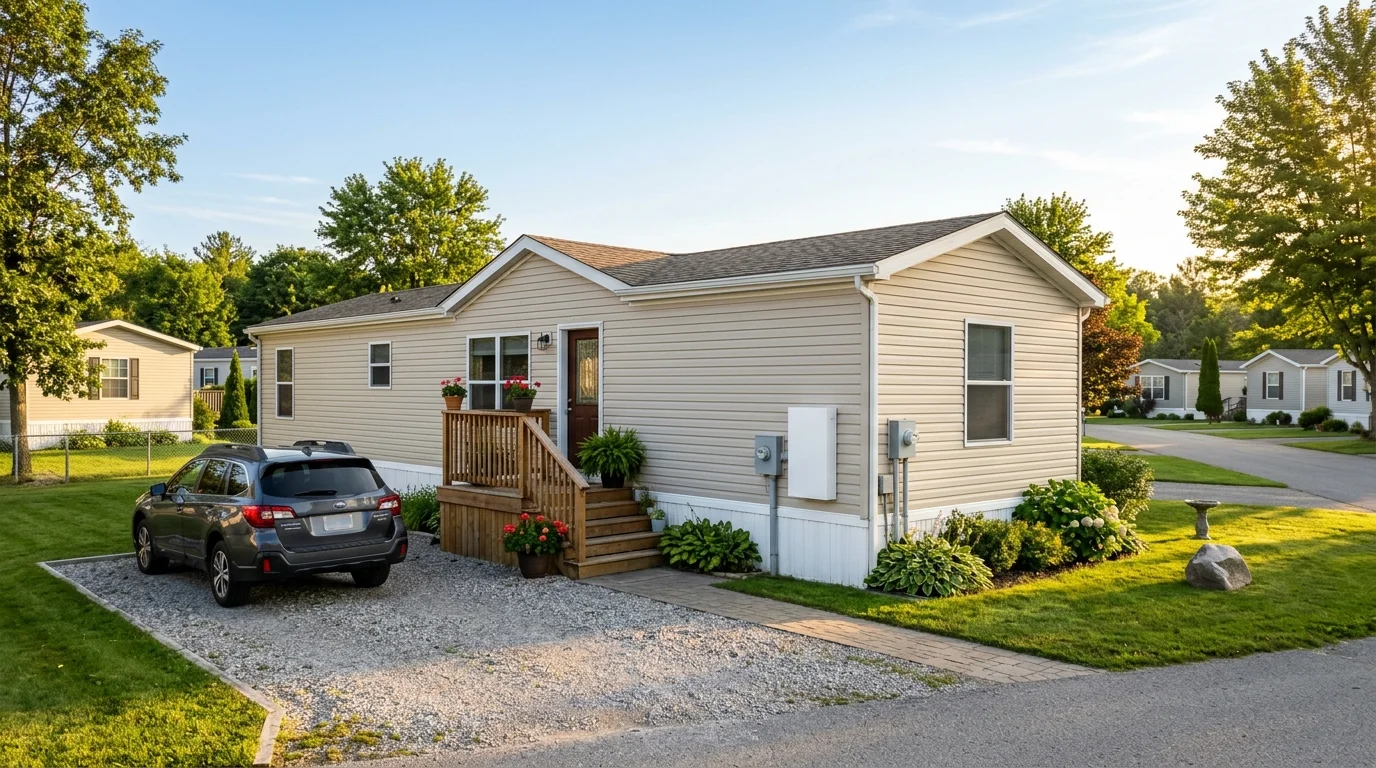
About 22 million Americans live in manufactured homes, roughly 6.7% of the US housing stock (Eye On Housing / NAHB, 2025). Most battery storage financing content never mentions them. It assumes a site-built home with a standard electrical panel and a clean real-property title, and none of those three assumptions automatically hold for a manufactured or mobile home.
A home's legal status, not its wiring, is usually the first fork in the road on a manufactured-home battery deal. Structural code, panel amperage, and how the home is titled all shape whether a project moves forward and how it gets financed. This guide walks through each of those factors and where financing fits once they're understood.
> Key Takeaways
> - About 22 million Americans live in manufactured homes, 6.7% of US housing stock (Eye On Housing / NAHB, 2025).
> - HUD wind-zone rules under 24 CFR Part 3285 govern anchoring and can limit where a battery enclosure sits on the lot.
> - Roughly 42% of manufactured housing loans nationally are chattel loans rather than real-property loans (Urban Institute / CFPB analysis, 2022 data), which affects the home's own financing, not the battery equipment loan itself.
> - Eos Loan is a direct lender. It finances battery energy storage with flexible terms from 6 to 240 months, subject to approval and eligibility.
Offer your customers flexible financing on essential projects
What makes a manufactured or mobile home different for a battery storage install?
HUD Code construction, in effect since 1976 and still governing manufactured housing today, sets structural and wind-zone standards that a site-built home simply doesn't carry (24 CFR Part 3285). That single fact reshapes where equipment can go and how it has to be anchored.
Homes in HUD Wind Zone II and Wind Zone III need vertical ties and longitudinal ground anchors under the federal construction standard (24 CFR Part 3285 (eCFR)). A battery enclosure sited too close to those tie-down points, or in a way that blocks required clearances, can trigger a redesign after the crew has already shown up.
Most battery storage content assumes a permanent-foundation home and skips this entirely. On a manufactured or mobile home, the wind zone and the tie-down layout should be confirmed before a battery enclosure's siting is finalized, not after.
Isn't that just an installer's problem, not a financing one? Not quite. A project that has to be resited mid-install delays the funding draw and can change the final invoice, which is exactly the kind of surprise that a lender and a homeowner both want to avoid before signing.
Does a manufactured home's electrical panel support battery storage?
Usually not without a check first. The federal standard sets a 100-amp minimum electric service for manufactured and mobile homes, and that minimum is frequently too thin once a battery system's charge controller and inverter load are added on top of existing circuits (eCFR, 24 CFR Part 3285).
A panel upgrade from 100 amps to 150 or 200 amps typically runs $1,500 to $4,000, depending on the scope of work and local labor rates (Home Depot panel upgrade guidance). That's a real line item, and it belongs in the proposal from the first conversation, not discovered mid-install.
!A licensed electrician working on an open residential electrical panel in a bright garage.
According to federal construction standards, manufactured and mobile homes carry a 100-amp minimum electric service requirement, a threshold set decades before battery storage systems existed as a common add-on load (24 CFR Part 3285 (eCFR)). A licensed electrician's load calculation, run before the proposal is finalized, is the only reliable way to know whether that minimum still has room for a battery system today.
Is a manufactured home battery loan a chattel loan or a real-property loan?
It depends on how the home itself is titled, and that distinction matters more here than in almost any other housing segment. Roughly 42% of manufactured housing loans nationally are chattel loans rather than real-property loans (Urban Institute / CFPB analysis, 2022 data).
A chattel loan treats the home as personal property, similar to a vehicle title. A real-property loan applies when the home sits on owned land with a permanent foundation and the title has been converted accordingly. That distinction affects the home's own financing market, not a separately financed battery system, but it's still worth understanding because it shapes how a homeowner thinks about debt and equity on the property overall.
Here's the compliance line that matters most: a battery storage loan from Eos Loan finances the battery equipment and installation, as a separate transaction from however the home itself is titled or mortgaged. It is never a mortgage, a refinance, or tied to the home's own title status.
Context on the home's own financing market shows why titling status carries weight. Chattel-titled manufactured home financing averaged roughly an 8% interest rate with about a 66% denial rate, versus roughly 5.5% and 43% denial for real-property titled financing, based on 2022 mortgage data (CFPB HMDA-based report). Those figures describe the home's own mortgage-market financing, sourced directly to CFPB, and they are not a statement about Eos Loan's battery storage rates or approval odds.
In our experience underwriting battery equipment loans on manufactured homes, titling status rarely blocks the equipment financing itself. It mostly changes how the conversation should be framed: an installer who confirms titling status upfront avoids presenting the deal as something it isn't.
Why does this distinction get confused so often? Because "mortgage" and "chattel" are loaded words in manufactured housing, and most sales conversations borrow language from the home's own financing without separating it from the equipment loan. Keeping those two transactions distinct, out loud, in the first conversation, prevents that confusion from reaching the homeowner.
What does financing a battery storage system for a manufactured home look like in practice?
Eos Loan finances the battery equipment and installation directly, as its own transaction separate from the home's title status, with flexible terms from 6 to 240 months, subject to approval and eligibility. As a direct lender, Eos Loan never routes a deal through a broker or marketplace, and it charges no dealer fee.
Before quoting, an installer should gather four things: the panel's existing amperage, the home's HUD wind zone, whether the land is owned or leased, and whether the property sits in a land-lease community with its own siting rules. Collecting those upfront shortens the quoting cycle and avoids a change order after the crew arrives.
For a full breakdown of how loan length, payment size, and total cost interact, see how battery storage loan terms work. For the underwriting factors that shape approval generally, see credit requirements for battery storage financing.
Add financing to your installs, talk to our team
Where can the battery enclosure go on a manufactured home lot?
Setback rules, skirting, and wind-zone anchoring narrow the siting options more on a manufactured home lot than on a typical site-built lot. That's before a land-lease community's own rules even enter the picture.
An estimated 4.3 million manufactured home sites exist in the US, spread across roughly 44,000 manufactured home communities, and about 30% of new manufactured homes are placed into a community rather than on owned land (Eye On Housing / NAHB, 2025). Many of those communities carry their own HOA-style restrictions on exterior equipment, separate from HUD's federal anchoring rules.
Confirming a community's siting rules before install day, the same way an installer confirms wind zone and panel amperage, avoids a change order that shows up after the crew has already scheduled the job.
How does battery storage financing for a manufactured home compare to an off-grid setup?
Many manufactured homes sit in rural areas or communities with grid-reliability profiles closer to an off-grid property than to a typical suburban site-built home, but the two aren't the same project. An off-grid system is sized to be the entire power source; a manufactured home on grid power with battery backup is sized differently and financed the same way as other grid-tied residential battery systems.
For the full sizing and cost mechanics of a fully off-grid battery bank, see off-grid battery storage financing rather than repeating that ground here. For how financed and cash purchases compare over the system's life, see financed vs. cash total cost of ownership. For the foundational rules across residential and commercial battery storage deals, see the complete battery storage financing guide for installers.
Become an Eos Loan financing partner
Prefer to talk it through? Call +1 833-989-3737.
Frequently Asked Questions
question: "Can a manufactured or mobile home get battery storage financing?",
answer: "Yes, subject to approval and eligibility. Eos Loan is a direct lender that finances the battery system and installation with flexible terms from 6 to 240 months, separate from however the home itself is titled or mortgaged."
},
{
question: "Does a mobile home need an electrical panel upgrade before adding battery storage?",
answer: "It depends on existing amperage and load. The federal minimum is 100 amps, which is often too thin once a battery system's inverter and charge controller are added. A licensed electrician's load calculation settles the question before quoting."
},
{
question: "Is a manufactured home battery storage loan the same as a chattel mortgage?",
answer: "No. A battery storage loan finances the battery equipment and installation as its own transaction. It is separate from however the home itself is titled or mortgaged, and it is never a mortgage or refinance of the home."
},
{
question: "Does the home's wind zone affect where a battery enclosure can be installed?",
answer: "Yes. HUD Wind Zones I, II, and III set anchoring and tie-down requirements under 24 CFR Part 3285, and Wind Zone II and III homes need vertical ties and longitudinal ground anchors that can limit enclosure placement."
},
{
question: "Can someone in a manufactured home community finance battery storage?",
answer: "Yes, though community siting rules for exterior equipment should be confirmed before installation. About 30% of new manufactured homes are placed in a land-lease community, many of which set their own rules beyond HUD's federal standards."
}
]} />
The bottom line for manufactured and mobile home battery storage financing
About 22 million Americans live in manufactured homes (Eye On Housing / NAHB, 2025), and most battery storage financing content still writes as if that housing type doesn't exist. Three checks separate a smooth deal from a delayed one:
- Confirm the HUD wind zone and tie-down layout before finalizing where the enclosure sits.
- Run a load calculation on the existing panel before assuming it can carry a battery system.
- Ask about titling status early, and keep the battery equipment loan clearly separate from however the home itself is titled.
Eos Loan is a direct lender, never a marketplace or broker, financing battery energy storage with flexible terms from 6 to 240 months, subject to approval and eligibility, with no dealer fee. For the full residential and commercial product landscape, see Eos Loan's battery energy storage financing.
About the author: Eduardo Donadi is CEO of Eos Loan, a US fintech direct lender. He helps installers and contractors offer point-of-sale financing on essential projects, including battery energy storage, EV chargers, and water filtration.