

Off-Grid and Cabin Battery Storage: Financing Options for Remote Properties
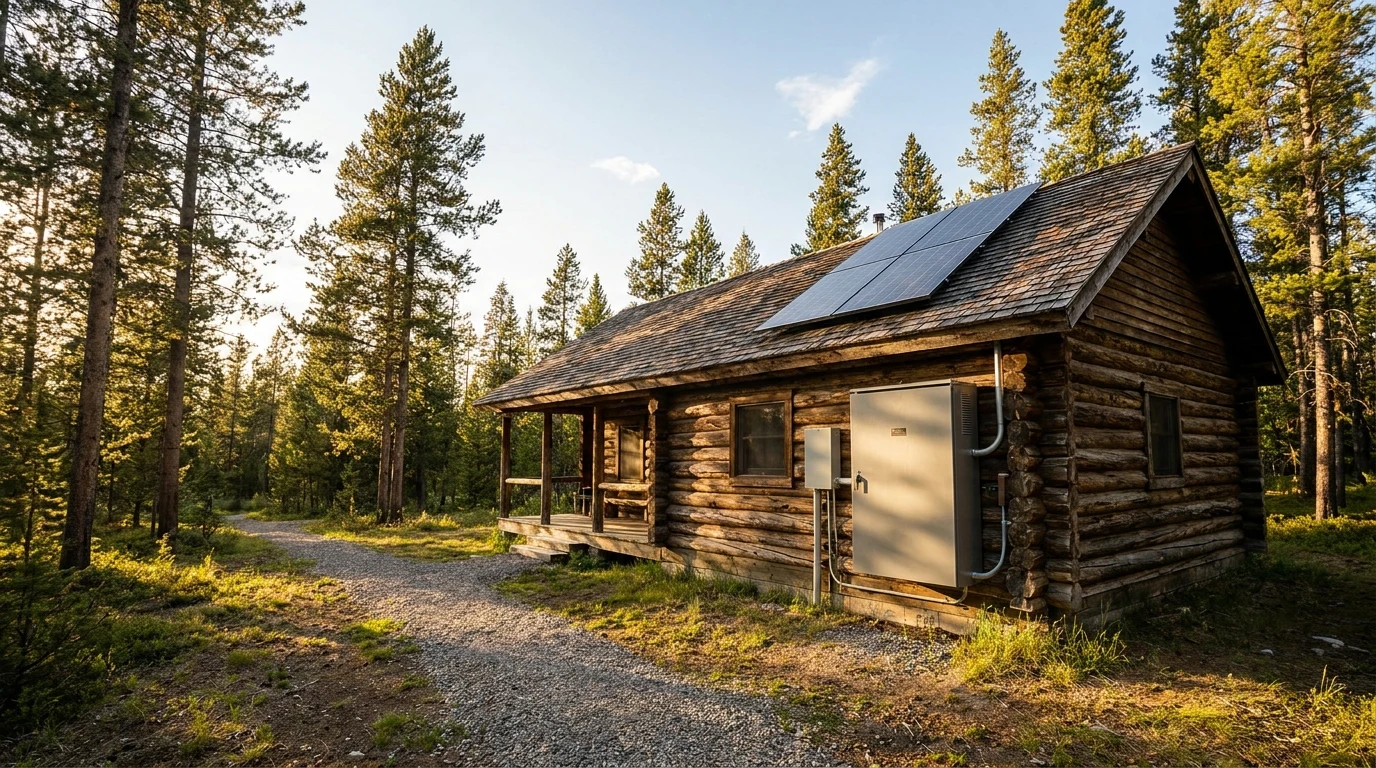
An estimated 4.3 million US housing units are classified as seasonal, recreational, or occasional-use (US Census Bureau, 2023), and a large share of them sit far enough from existing lines that grid power is expensive, slow to install, or simply unavailable. Cabins, ranches, hunting properties, and rural parcels do not run on the same battery math as a typical suburban home with backup.
Off-grid and cabin battery systems are bigger, cost more upfront, and get sized differently than the grid-tied backup batteries most installers quote every day. That difference confuses both property owners and the installers bidding the job. Can a 70 kWh off-grid bank even be financed? Is it cheaper than paying a utility to run a line? This guide breaks down how off-grid systems are sized, what they cost against the real alternative, and how financing fits.
> Key Takeaways
> - 4.3 million US housing units are seasonal, recreational, or occasional-use (US Census Bureau, 2023), a large pool of potential off-grid and cabin battery projects.
> - Off-grid battery banks typically need 60 to 90 kWh of usable capacity, three to six times the 10 to 20 kWh a grid-tied backup system carries (EnergySage).
> - Extending utility power to a remote parcel commonly costs $10,000 to $50,000, and can exceed $60,000 for longer runs (HomeGuide, 2026).
> - Eos Loan finances battery energy storage as a direct lender on flexible terms from 6 to 240 months, subject to approval and eligibility.
See how Eos Loan financing helps you close more projects
What Counts as an Off-Grid or Remote-Property Battery Storage System?
An off-grid battery system is a standalone power source with no utility connection at all, which is a different project than a grid-tied backup battery that supplements existing utility service. Remote-property systems typically serve cabins, ranches, hunting properties, and rural parcels among the 4.3 million seasonal-use US homes (US Census Bureau, 2023).
It helps to separate three scenarios installers run into, because each one sizes and finances differently:
- Fully off-grid: no utility line exists on the property at all. The battery bank, solar array, and often a backup generator are the entire electrical system.
- Remote grid-tied with backup: a utility line reaches the property, but outages are frequent enough (or the line is thin enough) that the owner wants substantial battery backup layered on top.
- Cabin or seasonal-use: intermittent occupancy changes the sizing math. A property used four weekends a month has different autonomy needs than one occupied year-round.
- Off-grid banks need 60 to 90 kWh of usable capacity, not the 10 to 20 kWh a grid-tied backup job uses.
- Grid line extension is frequently the more expensive, slower option once distance from the nearest line grows.
- Eos Loan finances the full off-grid scope, panels, battery bank, and generator, as one project on flexible terms from 6 to 240 months, subject to approval and eligibility.
- Pitch the financed system against the utility's quote, not against a cash price, and the conversation gets easier.
- US Census Bureau, "Vacant Seasonal Housing," 2023. Retrieved 2026-07-10. https://www.census.gov/library/stories/2023/05/vacant-seasonal-housing.html
- EnergySage, "What does it mean to go off the grid?", 2026. Retrieved 2026-07-10. https://www.energysage.com/solar/what-does-it-mean-to-go-off-the-grid/
- HomeGuide, "Cost to Get Utilities on Land," 2026. Retrieved 2026-07-10. https://homeguide.com/costs/cost-to-get-utilities-on-land
- Pioneer Electric Cooperative, line-extension cost pricing, 2026. Retrieved 2026-07-10. https://pioneerelectric.coop/my-account/help/line-extension-cost/
- NREL / US Department of Energy, hybrid power system cost-effectiveness for isolated grids, 2019. Retrieved 2026-07-10. https://docs.nrel.gov/docs/fy19osti/72509.pdf
- IRS, Residential Clean Energy Credit (Section 25D), 2025. Retrieved 2026-07-10. https://www.irs.gov/credits-deductions/residential-clean-energy-credit
That 4.3 million figure is down from 4.6 million in 2010 (US Census Bureau, 2023), but it still represents a meaningful, underserved pool of potential battery energy storage projects for installers who serve rural or recreational-property markets.
Why Are Off-Grid Battery Banks Bigger Than Grid-Tied Systems?
Off-grid battery banks typically need 60 to 90 kWh of usable capacity to cover a full day's household use with several days of autonomy built in, three to six times the 10 to 20 kWh a typical grid-tied backup battery carries (EnergySage). That gap is the single biggest reason off-grid quotes surprise both owners and first-time installers.
A grid-tied backup system only has to bridge an outage, usually hours to a couple of days, before utility power returns. An off-grid system has no fallback. It has to carry the household through cloudy stretches, winter's shorter solar days, and normal daily use indefinitely. Installers typically plan for three to five days of autonomy at average household draw, then size the array and bank to recharge that reserve on the next sunny day.
Chemistry matters here too. LFP (lithium iron phosphate) batteries dominate off-grid banks because they tolerate deep, repeated depth-of-discharge cycling far better than older chemistries, which matters when the bank is being drawn down close to its floor most nights rather than the shallow cycling a grid-tied backup battery sees during occasional outages.
Is It Cheaper to Finance Off-Grid Batteries or Extend Utility Power?
Extending utility power to a remote parcel commonly costs $10,000 to $50,000, and can exceed $60,000 for longer runs (HomeGuide, 2026), which is why a financed off-grid battery system is often the more practical path once distance from the nearest line grows. This is the comparison that should anchor every off-grid sales conversation, and most installers never make it explicit.
Real utility rate schedules make the distance math concrete. Pioneer Electric Cooperative publishes overhead line-extension pricing that runs from roughly $6,000 for a quarter-mile extension up to $23,166 for a full mile (Pioneer Electric Cooperative, 2026). That is one utility's published schedule, but it is representative of what rural cooperatives across the country charge, and it does not include the wait time, often months, to get on the utility's construction schedule.
Here is the reframe that changes how installers should pitch this job: for many remote parcels, the real competitor to an off-grid battery loan is not cash, and it is not another lender. It is the utility company's line-extension quote. Once you position the financed monthly payment against that number instead of against a hypothetical all-cash price, the conversation moves from "can you afford solar and storage" to "here is the faster, and often cheaper, way to get power to this property at all."
Add financing to your installs, talk to our team
How Does Off-Grid Battery Storage Financing Work?
Eos Loan finances battery energy storage as a direct lender, subject to approval and eligibility, with flexible terms from 6 to 240 months, letting a larger off-grid battery bank carry a monthly payment sized against what a grid connection or generator fuel would otherwise cost. Because Eos Loan underwrites and funds directly, there is a single approval event for the whole project rather than a chain of intermediaries.
That matters more for off-grid systems than for a typical grid-tied backup job, because an off-grid quote usually bundles more line items into one ticket: a larger solar array to feed the bigger bank, the battery bank itself, an inverter or charge controller sized for whole-home off-grid use, and often a backup generator. Financing the full scope as a single project, instead of financing the panels separately from the storage, keeps the underwriting simple and keeps the installer from having to explain two different loans to one customer.
Longer terms are what make a 60 to 90 kWh bank quotable in the first place. Stretching the payment over a longer horizon brings a whole-home off-grid system's monthly number down into range with what an owner might otherwise pay for a partial grid connection or ongoing generator fuel, without anyone having to discount the system itself. As always, no dealer fee is added to the loan, and no specific rate or approval outcome is promised here. Every application is subject to approval and eligibility. For a breakdown of how term length changes the monthly number, see how loan terms and monthly payments work.
What Role Do Backup Generators Play in an Off-Grid Battery System?
Hybrid systems that pair solar-plus-battery storage with a backup generator are generally more cost-effective than a generator-only setup for isolated, off-grid power needs (NREL, US Department of Energy). A generator in an off-grid system is a backstop, not the primary source, and that distinction changes how the whole project should be sized and quoted.
The generator's job is to cover the rare extended cloudy stretch when the solar array cannot recharge the bank fast enough, not to run daily. Including a modest generator in the financed project scope, rather than treating it as a separate cash purchase the owner handles later, lets the battery bank stay reasonably sized instead of being oversized purely to cover a worst-case week that a generator can handle for a fraction of the added battery cost.
What I'm seeing from installers quoting rural and cabin properties: the battery bank size, not the panel count, is what drives the loan amount up on these jobs. A financed off-grid system with a right-sized generator backstop tends to close faster than one where the installer tried to eliminate the generator entirely and oversized the bank to compensate. This is a pattern I've observed across our installer partners, not a guarantee for every site.Framing this correctly matters for essential projects like off-grid power. An off-grid battery-plus-generator system is not a discretionary purchase, it is the property's entire electrical infrastructure, and quoting it as one financed project reflects that reality better than splitting it into pieces.
How Should Installers Quote Off-Grid Systems for Bigger Tickets?
Off-grid and cabin battery projects run a larger scope than a typical grid-tied backup quote, and financing that full scope, panels, battery bank, and backup generator, as one ticket raises average project size while keeping the customer's payment manageable. That is the practical opportunity in this niche for installers who already serve rural or recreational-property service areas.
The sizing conversation and the financing conversation are the same conversation on these jobs. Days of autonomy, whether the owner wants a generator included, and seasonal occupancy patterns all feed directly into how big the bank needs to be, and the bank size is what drives the loan amount. Quoting the full off-grid scope as one project, instead of trimming it down to fit a cash budget the owner mentioned upfront, is what turns a modest backup job into a whole-property electrification project.
For installers building a broader playbook around bigger tickets, raising average ticket size walks through how financing the complete scope, rather than the cheapest version of a job, increases both close rates and per-job revenue across essential projects generally, not just off-grid work.
Does the Tax Credit Apply to Off-Grid Battery Systems?
The residential clean-energy credit (Section 25D) ended for property placed in service after December 31, 2025 (IRS, 2025), so an off-grid battery system financed today should be framed as financing, not as a credit, rebate, or incentive. That applies whether the property is a primary residence, a cabin, or a seasonal-use parcel.
This is general information, not tax advice. Consult a qualified tax professional about how the credit's expiration, or any state-level program that may still apply in a given location, affects a specific project. For the broader post-credit playbook, see financing a home battery after the tax credit.
Become an Eos Loan financing partner
Or call +1 833-989-3737 to talk through a financing program for your business.
question: "How much bigger does a battery bank need to be for an off-grid system?",
answer: "Off-grid battery banks typically need 60 to 90 kWh of usable capacity, three to six times the 10 to 20 kWh a grid-tied backup system carries (EnergySage, 2026). The bigger bank has to cover full daily use plus several days of autonomy, since there is no utility line to fall back on."
},
{
question: "Is it cheaper to finance an off-grid battery system or run a power line to a remote property?",
answer: "Often, yes. Line extensions commonly run $10,000 to $50,000, and can exceed $60,000 for remote parcels (HomeGuide, 2026). A financed off-grid battery system spreads the cost over 6 to 240 months instead of one lump-sum utility invoice, and it can often be installed faster than a utility construction schedule allows."
},
{
question: "Can you finance a cabin or off-grid battery storage system?",
answer: "Yes. Eos Loan finances battery energy storage as a direct lender, subject to approval and eligibility, on flexible terms from 6 to 240 months. The full off-grid scope, panels, battery bank, and generator, can typically be financed as one project."
},
{
question: "Do off-grid systems still need a backup generator?",
answer: "Often, yes, as a backstop for extended cloudy stretches. Hybrid solar-plus-battery-plus-generator setups are generally more cost-effective than generator-only systems for isolated, off-grid power needs (NREL, US Department of Energy). The generator is meant to be a rare-use backstop, not the primary power source."
},
{
question: "Does the tax credit apply to an off-grid battery system?",
answer: "The residential Section 25D credit ended for property placed in service after December 31, 2025 (IRS). An off-grid battery system financed today should be treated as financing rather than a tax benefit. This is general information, not tax advice; consult a qualified tax professional."
}
]} />
The Bottom Line on Off-Grid Battery Financing
Off-grid and cabin battery systems are a different job than grid-tied backup, both in how they're sized and in how they should be sold. The battery bank alone runs three to six times larger than a typical backup system (EnergySage), and the real number to beat is often the utility's own line-extension quote, which can run well past $60,000 on a long rural run (HomeGuide, 2026).
Four things to carry into the next remote-property quote:
For the full financing playbook this niche sits inside, see the complete battery storage financing guide, and for how standalone battery loans are structured more generally, see how standalone battery financing is structured.
About the author: Eduardo Donadi is CEO of Eos Loan, a US fintech direct lender that helps installers and contractors offer point-of-sale financing on essential projects, including battery storage, EV chargers, and water filtration.
---
Sources: