

A homeowner just got the water test results back. Lead. Hardness. PFAS. Now they need to choose: treat one tap or every tap in the house. That single decision determines the price, the coverage, and whether a monthly payment is what closes the deal.
The POU vs whole-home choice is where most customers stall. The difference in coverage is not obvious, and neither is the price gap, until someone explains it clearly. This post covers both system types, cost ranges (cited to external sources), what each one solves, and how financing changes the close rate for each.
> Key Takeaways
> - Point-of-use (POU) filters treat water at a single outlet and typically cost $200 to $1,000 installed (Angi, 2024).
> - Whole-home (point-of-entry) systems treat every tap and range from $800 to $5,000 or more depending on technology.
> - In 2025, POU systems held a 76.6% share of the water treatment market (Precedence Research, 2025), but whole-home systems carry the larger tickets where financing most often makes the difference.
> - Both system types qualify for water treatment financing through a dealer, subject to approval and eligibility.
Offer your customers flexible financing on essential projects
What is a point-of-use water filter?
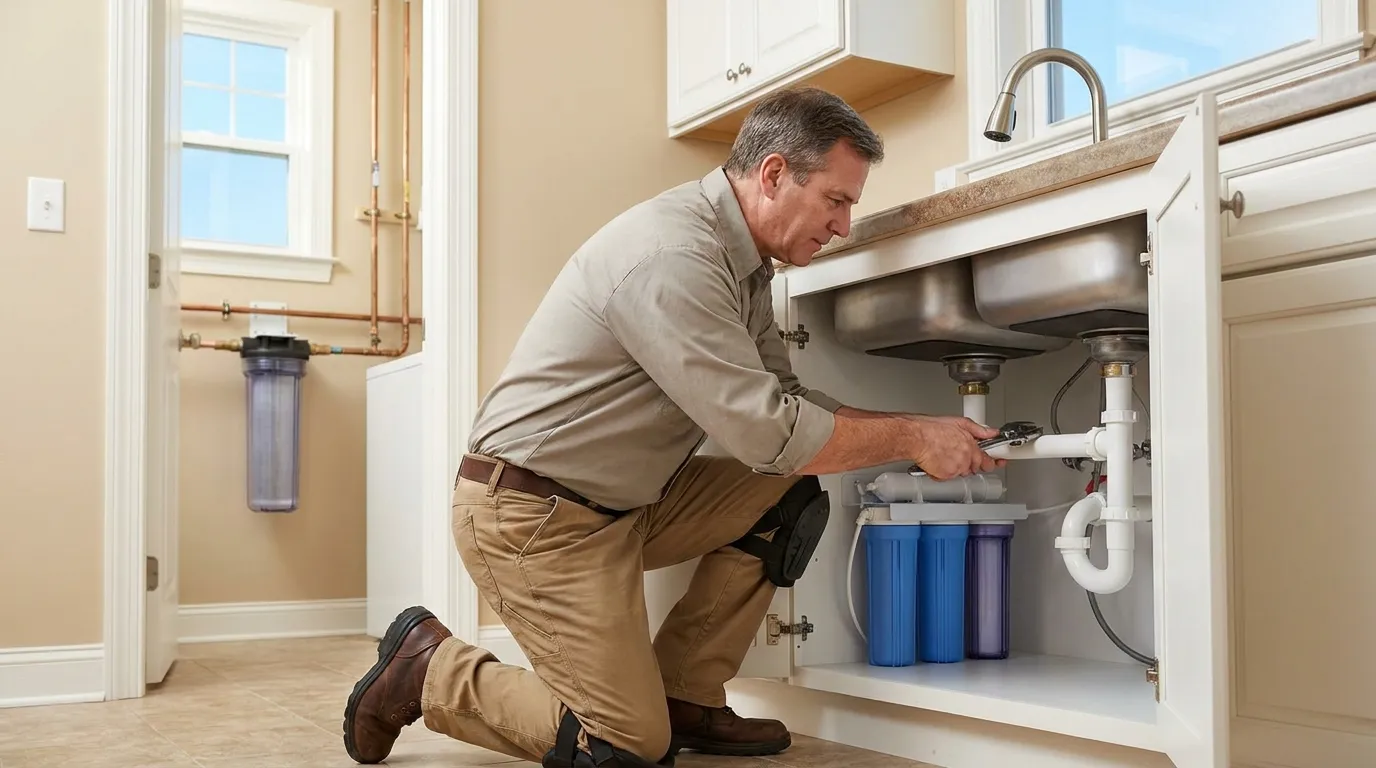
In 2025, point-of-use systems held a 76.6% share of the water treatment market (Precedence Research, 2025). A point-of-use filter treats water at a single outlet: a kitchen tap, a refrigerator line, or a dedicated drinking faucet. It addresses the contamination problem exactly where the water is consumed, not at the home's entry point.
The three most common POU types are:
- Under-sink reverse osmosis (RO): Removes PFAS, lead, nitrates, and dissolved solids. Installs below the kitchen sink with a dedicated faucet. This is the workhorse for households with contamination concerns at the drinking tap.
- Countertop filter: Carbon-based, handles chlorine, taste, and VOCs. No permanent plumbing change needed, which makes it a low-barrier entry for renters or customers not ready for an under-sink installation.
- Inline refrigerator filter: Treats water at the ice maker and refrigerator dispenser. Usually carbon-based; addresses taste and odor more than dissolved contaminants.
- Water softener: Targets hardness (calcium and magnesium). Protects water heaters, pipes, and appliances from scale buildup. The single most common whole-home installation across the country.
- Whole-house carbon filter: Reduces chlorine, chloramines, VOCs, and taste across every tap. Often paired with a softener.
- Sediment filter: Removes particulates at the main line. Commonly the first stage in a multi-stage system.
- Iron or sulfur filter: Required on well water with iron, manganese, or hydrogen sulfide. Without it, water stains fixtures and smells.
- Multi-stage POE system: Combines softening, carbon, and sometimes UV disinfection into one system. Highest cost, broadest coverage.
- Under-sink RO unit: $150 to $700 for the system itself
- Countertop filter: $50 to $200 for the unit
- Installation labor: $100 to $300
- Annual filter replacement: $50 to $200 per year
- Water softener: $400 to $2,500 for the unit, plus $200 to $500 in installation labor
- Whole-house carbon filter: $300 to $1,500 plus installation
- Multi-stage POE system: $800 to $4,000 or more for the system, plus labor
- Total for a softener plus POE carbon filter: $1,500 to $4,500 installed
- The customer applies through the dealer's financing program.
- A direct lender like Eos Loan underwrites the application and funds the loan.
- The dealer gets paid by ACH after install, often within one to two business days.
- The customer repays the lender over flexible terms, subject to approval.
- Precedence Research, Water Treatment Systems Market (point-of-use 76.6% share; reverse osmosis 28.0% equipment demand share in 2025), retrieved 2026-06-18, https://www.precedenceresearch.com/water-treatment-systems-market
- Fortune Business Insights, US Water Softening Systems Market ($763.6M in 2025, projected $1.19B by 2032 at 6.5% CAGR), retrieved 2026-06-18, https://www.fortunebusinessinsights.com/u-s-water-softening-systems-market-109926
- Angi, How Much Does a Water Filtration System Cost? (POU installed $200 to $1,000; whole-home $800 to $5,000+), retrieved 2026-06-18, https://www.angi.com/articles/how-much-does-water-filtration-system-installation-cost.htm
- US Environmental Protection Agency, Lead and Copper Rule Improvements (lead action level lowered from 15 to 10 ppb; effective December 30, 2024; compliance November 1, 2027), retrieved 2026-06-18, https://www.epa.gov/ground-water-and-drinking-water/lead-and-copper-rule-improvements
- US Environmental Protection Agency, PFOA and PFOS Compliance Extension Rule (2024 enforceable MCLs for PFOA and PFOS; 2025 compliance timeline), retrieved 2026-06-18, https://www.epa.gov/sdwa/proposed-pfoa-and-pfos-compliance-extension-rule
What makes POU appealing is the lower price and faster install. A plumber can have an under-sink RO running in two to three hours. No need to tap the main supply line. For customers whose water test shows a localized contaminant at the drinking tap, POU is the right answer.
POU systems are also the systems most homeowners have already seen advertised. That brand familiarity lowers the educational barrier during the sales conversation. For a deeper look at how dealers finance both POU and whole-home projects under one program, see our water treatment dealer financing guide.
According to Precedence Research's Water Treatment Systems Market report (2025), point-of-use systems captured 76.6% of the market by type in 2025, with reverse osmosis alone accounting for 28.0% of total equipment demand. This positions under-sink RO as the category's most financially significant single system type, meaning the majority of financed POU tickets are RO units at the kitchen tap.
What is a whole-home water filtration system?
The US water softening market was valued at $763.6 million in 2025, projected to reach $1.19 billion by 2032 at a 6.5% CAGR (Fortune Business Insights, 2025). A whole-home system, also called a point-of-entry (POE) system, treats all water entering the house at the main supply line. Every tap, shower, dishwasher, and appliance receives treated water.
Common whole-home system types include:
The problems that most often drive a whole-home recommendation are: high hardness across the house, iron or sulfur in well water, widespread PFAS concern, or a lead service line serving the entire structure.
The size of the US water softening market reflects just how common hardness problems are. At $763.6 million in 2025 and growing to $1.19 billion by 2032 (Fortune Business Insights, 2025), the softener category alone is a substantial business. Water treatment dealers who can finance these installs are positioned to capture a larger share of that growth. For a deeper look at whole-home financing programs, see our water softener and whole-home system financing programs.
POU vs Whole-Home: What Does Each System Actually Solve?
The right system depends on the contaminant and how widespread it is in the home. POU solves a single-tap problem at lower cost. Whole-home solves a whole-house problem, including hardness that damages appliances and pipes silently over time.
Here is a side-by-side comparison:
| | POU (Point-of-Use) | Whole-Home (Point-of-Entry) |
|---|---|---|
| Coverage | Single tap or outlet | Every tap, appliance, and shower |
| Best for | PFAS, lead, nitrates, taste/odor at the drinking tap | Hardness, iron, sulfur, whole-house chlorine, well water |
| Installed cost | $200 to $1,000 | $800 to $5,000+ |
| Maintenance | Filter cartridge: $50 to $200/year | Salt/service: $100 to $400/year |
| Install complexity | Low (under-sink or countertop) | Higher (taps the main supply line) |
The EPA tightened two rules that have shifted what customers need. The Lead and Copper Rule Improvements (LCRI) lowered the lead action level from 15 to 10 parts per billion, effective December 30, 2024, with compliance required by November 1, 2027 (EPA, 2024). The EPA's 2024 PFAS rule set enforceable maximum contaminant levels for PFOA and PFOS (EPA, 2025). Both rules create specific, addressable problems that map directly to system types.
When a homeowner needs both systems: A customer whose water test shows hardness AND PFAS at the kitchen tap needs a softener for the whole house and an RO unit at the kitchen tap. Presenting these as a bundle with one monthly payment is a legitimate dual-recommendation, not an upsell for its own sake. The softener protects appliances and plumbing; the RO protects drinking water. The water test gives the dealer authority to recommend both.
The dealer framing is simple: let the water test drive the recommendation. A hardness reading pushes toward a softener. A PFAS or lead hit at the drinking tap pushes toward under-sink RO. Both results together mean both systems, and financing makes that combined ticket reachable.
How Much Does Each System Cost?
Point-of-use systems typically cost $200 to $1,000 installed; whole-home systems range from $800 to $5,000 or more depending on technology and home size (Angi, 2024). The price gap between system types is exactly where financing matters most.
POU cost breakdown:
A customer paying $400 to $800 for a well-installed under-sink RO is in a range where some can pay cash. Many still prefer to finance, but the payment is not usually the difference between yes and no.
Whole-home cost breakdown:
A $3,500 whole-home system is where sticker shock reliably kills deals. The homeowner knows they need it and wants it, but writing a check for $3,500 is a different conversation than agreeing to a monthly payment that fits the household budget.
The cost ranges make the financing case obvious: a $400 under-sink filter may or may not need a payment plan. A $4,000 whole-home softener-plus-carbon system almost always does. Presenting the monthly payment beside the cash price at the water test keeps the deal alive through sticker shock. For more on adding financing to your water installs, see our how to offer water filtration financing guide.
Add financing to your installs, talk to our team
Can You Finance a Point-of-Use or Whole-Home Water Filter?
Both system types qualify for water treatment financing through a dealer, subject to approval and eligibility. The monthly payment is what moves a $3,500 whole-home system from "I need to think about it" to a signed job. This is a pattern we see consistently: POU customers often have a price that fits their cash budget. Whole-home customers frequently need a payment plan before they say yes.
Here is how dealer financing works for both types:
The practical difference between POU and whole-home at the financing stage is ticket size. A $500 under-sink RO is financeable, and some customers want that option even when they could write the check. A $3,000 water softener plus installation is the deal type where showing a monthly payment at the water test can be the single variable that separates a closed job from a stalled one.
Eos Loan is a direct lender. We fund the loans we offer and charge no dealer fee. That means your system price stays honest: there's no markup required to cover a hidden fee buried in the quote. Financing is available for both POU and whole-home systems under one program, so a dealer whose customers span both system types works with one lender, one set of terms, one contact.
For water treatment, Eos Loan offers flexible terms, subject to approval and eligibility. We don't invent specific term lengths here because the right term depends on the job and the customer's budget. What matters is that the flexibility is real: the program covers both POU and whole-home systems under one agreement, one contact, and one funding process.
Both POU and whole-home water filtration systems can be financed through a dealer with Eos Loan as the direct lender, no dealer fee, and flexible terms subject to approval and eligibility. For whole-home systems where the installed cost runs $1,500 to $5,000 or more, the monthly payment is often what moves a hesitant customer from "I'll think about it" to a signed project. Dealers who have that payment option ready at the water test close more of the jobs they earn.
Which System Should a Homeowner Choose?
Start with the water test. The contaminant profile drives the recommendation, not personal preference, and not what the neighbor bought. A hardness problem needs a whole-home solution. A PFAS or taste problem at one tap needs a POU RO unit at the kitchen sink.
Here is the decision framework water treatment dealers use with customers:
1. Run a certified water test first. Either a dealer-run test or a state-certified lab. Generic strip tests do not detect PFAS, lead, or dissolved solids accurately enough to guide a system recommendation.
2. Hardness, sediment, iron, or sulfur across the house? Recommend a whole-home solution (softener, iron filter, or multi-stage POE). The problem is at the entry point and affects every appliance.
3. PFAS, nitrates, lead, or taste/odor at one tap? Recommend a POU reverse osmosis unit at the kitchen sink. The EPA's 2024 PFAS MCLs make this a regulatory concern, not just a preference (EPA, 2025).
4. Both results present? Recommend both: a softener for hardness across the house, and a POU RO at the kitchen tap for dissolved contaminants. The water test gives you the authority to make both recommendations. Presented as a single monthly payment, the bundle closes better than two separate quotes.
What I see across our dealer network: customers who test positive for both hardness and PFAS tend to be the ones most ready to finance a whole-home system plus a POU RO together. The two-contaminant result justifies the larger ticket, and the monthly payment makes it approachable. Customers who test positive for only one contaminant at one tap, usually PFAS or lead at the kitchen sink, are often POU-only buyers who can fit a $600 RO unit into their cash budget. The water test is not just a diagnostic tool. It's your sales authority.
!A homeowner holding a glass of clean water at a bright, sunlit kitchen sink.
For a broader look at how dealers add financing to every project type, see our contractor's guide to offering customer financing.
The choice comes down to the water test
POU systems solve single-tap problems at lower cost ($200 to $1,000 installed). Whole-home systems solve house-wide problems at higher cost ($800 to $5,000 or more). The water test tells you which problem exists. The price difference tells you whether financing is what closes the deal.
Both system types qualify for financing through a water treatment dealer with Eos Loan, subject to approval and eligibility. No dealer fee. Flexible terms. One direct lender for your full range of water projects.
To see how a test result becomes a financed install, walk through the full six-step sales workflow.
See how Eos Loan financing helps you close more projects
Or call +1 833-989-3737 to talk through a financing program for your business.
Frequently Asked Questions
{ question: "What is the difference between POU and POE water filters?", answer: "POU (point-of-use) treats water at a single tap or outlet, such as an under-sink RO unit at the kitchen sink. POE (point-of-entry, or whole-home) treats all water entering the home at the main supply line, covering every tap, shower, and appliance. The right system depends on where the contamination problem exists and how widespread it is." }, { question: "Which costs more, a point-of-use or whole-home water filter?", answer: "Whole-home systems cost more. POU systems typically run $200 to $1,000 installed; whole-home systems range from $800 to $5,000 or more depending on technology, system complexity, and home size. Water softeners with installation commonly run $600 to $3,000; multi-stage POE systems can reach $5,000 or more. Source: Angi, Water Filtration System Installation Cost, 2024." }, { question: "Can you finance a point-of-use water filter?", answer: "Yes. Both POU and whole-home systems can be financed through a water treatment dealer, subject to approval and eligibility. Monthly payments are especially impactful for whole-home systems where the upfront cost is highest. With Eos Loan as the direct lender, there is no dealer fee and terms are flexible, matched to the project and the customer's budget." }, { question: "Do I need both a softener and a reverse osmosis system?", answer: "Possibly, if your water test shows both hardness and PFAS or other dissolved contaminants at the drinking tap. A water softener treats hardness for the whole house, protecting appliances and plumbing. An under-sink RO unit at the kitchen tap targets PFAS, lead, nitrates, and dissolved solids at the point of consumption. A certified water test tells you which problem you actually have." }, { question: "What is the annual maintenance cost for each system?", answer: "POU filter cartridge replacement typically runs $50 to $200 per year depending on the system and water quality in your area. Whole-home water softener salt and annual service typically costs $100 to $400 per year. Multi-stage POE systems may require additional filter changes and annual inspections. Source: Angi, Water Filtration System Installation Cost, 2024." } ]} /> --- Sources
About the author: Eduardo Donadi is the CEO of Eos Loan, the fintech built to finance essential projects (battery energy storage, EV chargers, and water filtration) for installers, contractors, and resellers across the United States.