

State-by-State Financing Disclosure Requirements for Contractors
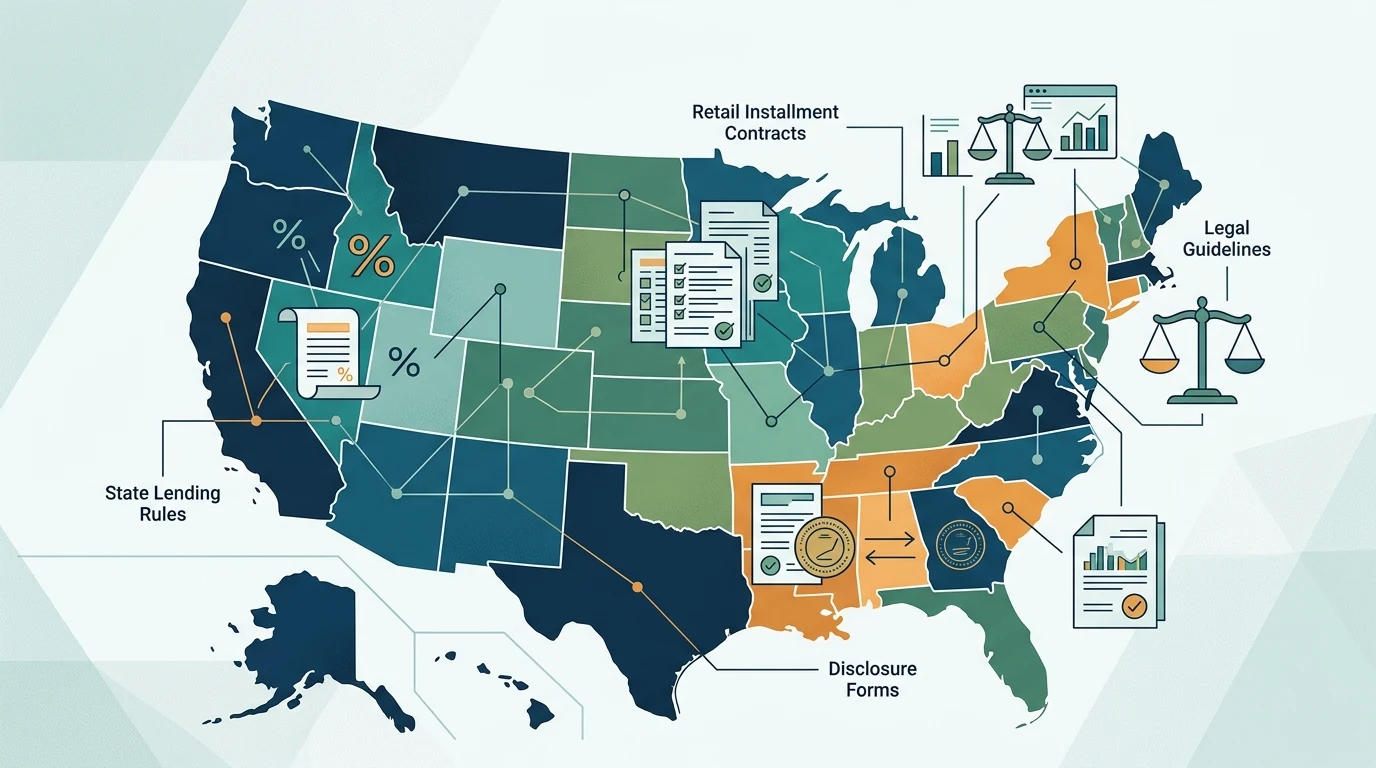
At least 10 states now have their own commercial financing disclosure statutes layered on top of federal Truth in Lending, and the list keeps growing (Venable LLP, State Commercial Financing Disclosure Laws, March 2026). A contractor who assumes "my lender is TILA-compliant" covers every state they sell in is missing a layer of law that shifts by state and changes fast.
This guide organizes state financing disclosure law into five categories, not a 50-state table, so you can identify which type of rule might apply to your program before you expand into a new state. This is general information, not legal advice. State law changes frequently; verify current requirements with counsel before launching a financing program in a new state.
> Key Takeaways
> - At least 10 states, including California, New York, Texas, Utah, and Virginia, have their own commercial financing disclosure statutes on top of federal TILA/Regulation Z (Venable LLP, March 2026).
> - State law adds five distinct categories: commercial financing disclosure statutes, retail installment sales acts, licensing-linked disclosure rules, cooling-off extensions, and PACE-specific regimes.
> - The CFPB confirmed state commercial-financing disclosure laws in California, New York, Utah, and Virginia are not preempted by federal TILA (CFPB determination, March 2023).
> - This is general information, not legal advice. Consult qualified counsel before launching a financing program in a new state.
See how Eos Loan financing helps you close more projects
Do Financing Disclosure Laws Vary by State?
Yes. Federal TILA/Regulation Z sets a disclosure floor, and states can add more. In March 2023, the CFPB confirmed that state commercial-financing disclosure laws in California, New York, Utah, and Virginia are consistent with, not preempted by, federal TILA (CFPB, Determination of Effect on State Laws, March 2023).
That determination matters because it settles a question contractors used to assume worked the other way: federal compliance does not automatically satisfy state law. A lender can meet every Regulation Z requirement and still owe a separate disclosure under a state's own statute. In 2026, Regulation Z generally covers consumer credit transactions of $73,400 or less, which includes most point-of-sale loans for battery storage, EV chargers, and water filtration (CFPB, threshold announcement, 2025).
!A contractor reviewing financing paperwork on a laptop at a sunlit desk
Most contractor-facing content treats "state law" as one undifferentiated blob, then tells you to "check your state." That framing is not useful when you are trying to figure out what actually applies to you. State law layers into five recognizable categories: commercial financing disclosure statutes, retail installment sales acts, licensing-linked disclosure rules, cooling-off period extensions, and PACE-specific disclosure regimes. Naming the category tells you which regulator, which statute, and which questions to ask a financing partner. For the federal layer these state rules sit on top of, see what Truth in Lending requires at the federal level.
What Is a Retail Installment Sales Act, and Does My State Have One?
Most states have a retail installment sales act (RISA) or home improvement finance act governing consumer credit sales tied to goods or services delivered at the buyer's home. A RISA typically mirrors TILA's core disclosure content, amount financed, finance charge, APR, total of payments, then adds state-specific extras like a notice-to-buyer statement or itemization rules.
Pennsylvania's Home Improvement Finance Act is a named example: it governs retail installment contracts for home improvement work and requires specific notice language to the buyer. Florida licenses certain home-improvement lenders as a Home Improvement Retail Installment Seller, a separate credential from a general lending license (Florida Office of Financial Regulation). California layers its own retail installment sales framework on top of federal requirements as well.
A RISA usually requires the buyer to receive a signed copy of the contract and states that the disclosure content, not marketing language, is what governs the transaction. If a state calls out "retail installment contract" as a defined term in its statute, that is a signal a RISA applies to point-of-sale financing sold there.
Which States Require a Commercial Financing Disclosure?
At least 10 states, including California (SB 1235, effective December 2022), New York, Utah, Virginia, Connecticut, Texas (HB 700, effective September 2025), Florida, Georgia, Kansas, and Missouri, now require a commercial financing disclosure for qualifying transactions, and New Jersey has similar legislation pending (Venable LLP, March 2026).
This is the category contractors most often confuse with their own point-of-sale program. Commercial financing disclosure statutes generally apply to business-purpose financing, equipment loans, sales-based financing, and merchant cash advances, not a typical consumer loan for a homeowner's battery storage, EV charger, or water filtration system. Confirm which category your program falls into before assuming a commercial-financing statute applies. Texas providers and brokers of sales-based financing must register with the Office of Consumer Credit Commissioner by December 31, 2026 (Mayer Brown, Texas Commercial Financing Disclosure and Registration Law, 2025).
Add financing to your installs, talk to our team
Does My State Link Contractor Licensing to Financing Disclosure?
Some states tie financing disclosure directly to the contractor's own license or registration, not just the lender's. New York requires a licensed home improvement contractor who arranges or facilitates financing to complete a disclosure form explaining that connection to the customer (NYC Department of Consumer and Worker Protection, Home Improvement Contractor Disclosures). Florida requires certain home-improvement lenders to hold a Home Improvement Retail Installment Seller license, which intersects with how a contractor's referral relationship gets structured (Florida OFR).
This category matters most directly to you, the contractor, because it can touch your own license status, not just your lender's paperwork. A New York City home improvement contractor license also carries a bonding or trust-fund requirement of $20,000 (NYC Department of Consumer and Worker Protection, Home Improvement Contractor Trust Fund), which shows how licensing and financing disclosure intersect operationally in practice, not just on paper.
When we bring a new dealer onto the Eos Loan platform in a state we have not underwritten before, the first compliance question is rarely "what does TILA require." It is "does this state's contractor-licensing law say anything about financing." That question changes the onboarding checklist more than any single federal rule does, because a licensing-linked disclosure requirement is something the contractor carries, not something a lender can absorb on their behalf.
How Long to Cancel a Financed Home Improvement Contract?
Federal law gives consumers a 3-business-day right to cancel for door-to-door and home-solicitation sales under the FTC's Cooling-Off Rule (FTC, 16 CFR Part 429). Many states extend this window or add protections on top of the federal floor, for example, longer periods in some states for sales to seniors.
Treat the federal 3-day window as the floor, not the final answer, for any given state. State cancellation-period extensions vary and change, so do not rely on a specific day count for any state without verifying it against current statutory text at the time you launch. If your sales process runs through a customer's home, confirm the applicable cancellation window with counsel before finalizing contract language for that state.
!Close-up of hands reviewing and signing a financing contract in daylight
What About State PACE Disclosure Rules?
States that allow Property Assessed Clean Energy (PACE) financing, repaid through property tax bills, generally layered their own homeowner-protection disclosures on top of the program before the CFPB's federal PACE rule took effect March 1, 2026 (CFPB, PACE final rule).
PACE is a narrower category than the others, generally available for solar and energy-retrofit projects in select states such as California, Florida, and Missouri. Contractors offering standard point-of-sale consumer loans, the model Eos Loan uses as a direct lender, are not operating inside the PACE structure. That distinction matters because PACE financing is secured by a property tax lien, while a point-of-sale consumer loan is not; the disclosure obligations, and who owes them, differ accordingly.
Offer your customers flexible financing on essential projects
How Should a Multi-State Contractor Track Disclosure Requirements?
Treat state-law tracking as an ongoing compliance task tied to each state you operate in, not a one-time checklist. New states are actively adding commercial financing disclosure statutes, Texas enacted its law in 2025 and New Jersey has one proposed, and existing state rules get amended without much notice.
A practical approach: run each state you operate in through the five categories above, commercial financing disclosure statutes, retail installment sales acts, licensing-linked rules, cooling-off extensions, and PACE-specific regimes, and note which ones apply. Ask any financing partner which categories they have already mapped for the states you sell in; a partner that cannot answer that question specifically has not done the work.
As a direct lender, Eos Loan's compliance team tracks state-level disclosure changes as part of underwriting for every state we fund in, since the lender, not the contractor, generally carries primary disclosure liability under TILA. That is one advantage of working with a direct lender instead of a chain of intermediaries: fewer parties that each need to independently track the same state-law changes. For the structural comparison behind that point, see direct lender vs. marketplace financing models, and for a broader vetting framework, see a due-diligence checklist for vetting a financing partner. Dealer fees are a related but separate disclosure issue; see how dealer fees work and where they hide for that layer. Eos Loan charges no dealer fee on any program it funds.
For the full picture of building a compliant financing program from the ground up, see the full 2026 contractor financing playbook.
Frequently Asked Questions
Do financing disclosure laws vary by state?
Yes. Federal TILA/Regulation Z sets a floor, and states add categories of requirements on top. The CFPB confirmed in March 2023 that state commercial-financing disclosure laws in California, New York, Utah, and Virginia are not preempted by TILA (CFPB determination, 2023).
What is a retail installment sales act?
A retail installment sales act (RISA) is a state law governing consumer credit sales, often home-improvement-specific, that typically mirrors TILA's core disclosure content plus added state requirements, such as Pennsylvania's Home Improvement Finance Act.
Which states require a commercial financing disclosure?
At least 10 states as of 2026, including California, New York, Utah, Virginia, Connecticut, Texas, Florida, Georgia, Kansas, and Missouri, with more states considering similar bills (Venable LLP, March 2026).
Does my state require a contractor license to offer financing?
Some states link financing-facilitation disclosure directly to the contractor's home improvement license, for example New York's requirement that licensed contractors who arrange financing complete a disclosure form on that connection.
How long can a customer cancel a financed home improvement contract?
Federal law provides a 3-business-day cooling-off right for door-to-door and home-solicitation sales (FTC, 16 CFR Part 429). Some states extend this window; verify current state text before relying on a specific number.
{ question: "Do financing disclosure laws vary by state?", answer: "Yes. Federal TILA/Regulation Z sets a floor, and states add categories of requirements on top. The CFPB confirmed in March 2023 that state commercial-financing disclosure laws in California, New York, Utah, and Virginia are not preempted by TILA (CFPB determination, 2023)." }, { question: "What is a retail installment sales act?", answer: "A retail installment sales act (RISA) is a state law governing consumer credit sales, often home-improvement-specific, that typically mirrors TILA's core disclosure content plus added state requirements, such as Pennsylvania's Home Improvement Finance Act." }, { question: "Which states require a commercial financing disclosure?", answer: "At least 10 states as of 2026, including California, New York, Utah, Virginia, Connecticut, Texas, Florida, Georgia, Kansas, and Missouri, with more states considering similar bills (Venable LLP, March 2026)." }, { question: "Does my state require a contractor license to offer financing?", answer: "Some states link financing-facilitation disclosure directly to the contractor's home improvement license, for example New York's requirement that licensed contractors who arrange financing complete a disclosure form on that connection." }, { question: "How long can a customer cancel a financed home improvement contract?", answer: "Federal law provides a 3-business-day cooling-off right for door-to-door and home-solicitation sales (FTC, 16 CFR Part 429). Some states extend this window; verify current state text before relying on a specific number." } ]} />The Bottom Line on State Financing Disclosure Law
Federal TILA is a floor, not a ceiling. At least five categories of state law can layer on top: commercial financing disclosure statutes, retail installment sales acts, licensing-linked disclosure rules, cooling-off extensions, and PACE-specific regimes. Commercial financing disclosure laws are the fastest-growing category, more than 10 states now, with more proposed. Licensing and disclosure are directly linked in some states, which puts a contractor's own credential on the line, not just a lender's paperwork.
This is general information, not legal advice. Consult qualified counsel to verify current requirements before launching a financing program in a new state. If you want to talk through what a direct-lender financing program with no dealer fee looks like as you expand state by state, our team is available.
Offer your customers flexible financing on essential projects
Or call +1 833-989-3737 to talk through a financing program for your business.
---
Sources
- Venable LLP, State Commercial Financing Disclosure Laws, March 2026, retrieved 2026-08-02, https://www.venable.com/insights/publications/2026/03/state-commercial-financing-disclosure-laws
- Consumer Financial Protection Bureau / Federal Register, Truth in Lending: Determination of Effect on State Laws (California, New York, Utah, and Virginia), March 2023, retrieved 2026-08-02, https://www.federalregister.gov/documents/2023/03/31/2023-06719/truth-in-lending-determination-of-effect-on-state-laws-california-new-york-utah-and-virginia
- Mayer Brown, Texas Commercial Financing Disclosure and Registration Law Threatens Sales-Based Financing Industry, 2025, retrieved 2026-08-02, https://www.mayerbrown.com/en/insights/publications/2025/06/texas-commercial-financing-disclosure-and-registration-law-threatens-sales-based-financing-industry
- Goodwin Law, California Finalizes Commercial Financing Regulations, 2022, retrieved 2026-08-02, https://www.goodwinlaw.com/en/insights/publications/2022/06/06_13-california-finalizes-commercial-financing
- New York City Department of Consumer and Worker Protection, Home Improvement Contractor Disclosures, retrieved 2026-08-02, https://rules.cityofnewyork.us/rule/home-improvement-contractor-disclosures/
- Florida Office of Financial Regulation, Home Improvement Retail Installment Seller, retrieved 2026-08-02, https://flofr.gov/divisions-offices/division-of-consumer-finance/home-improvement-retail-installment-seller
- Federal Trade Commission, 16 CFR Part 429 (Cooling-Off Rule), retrieved 2026-08-02, https://www.ecfr.gov/current/title-16/chapter-I/subchapter-D/part-429
- Consumer Financial Protection Bureau, CFPB Finalizes Rule to Protect Homeowners on Solar Panel Loans and Other Home Improvement Loans Paid Back Through Property Taxes (PACE final rule, effective March 1, 2026), retrieved 2026-08-02, https://www.consumerfinance.gov/about-us/newsroom/cfpb-finalizes-rule-to-protect-homeowners-on-solar-panel-loans-and-other-home-improvement-loans-paid-back-through-property-taxes/
- Consumer Financial Protection Bureau, Agencies Announce Dollar Thresholds for Applicability of Truth in Lending and Consumer Leasing Rules (2026 threshold of $73,400), retrieved 2026-08-02, https://www.consumerfinance.gov/about-us/newsroom/agencies-announce-dollar-thresholds-for-applicability-of-truth-in-lending-and-consumer-leasing-rules-for-consumer-credit-and-lease-transactions-2025/
- Consumer Financial Protection Bureau, Issue Spotlight: Solar Financing, August 2024, retrieved 2026-08-02, https://www.consumerfinance.gov/data-research/research-reports/issue-spotlight-solar-financing/
- New York City Department of Consumer and Worker Protection, Home Improvement Contractor Trust Fund, retrieved 2026-08-02, https://www.nyc.gov/site/dca/consumers/Home-Improvement-Contractor-Trust-Fund.page
About the author: Eduardo Donadi is the CEO of Eos Loan, the fintech built to finance essential projects (battery energy storage, EV chargers, and water filtration) for installers, contractors, and resellers across the United States.