International Pix: can foreigners use Pix and how to get paid from abroad
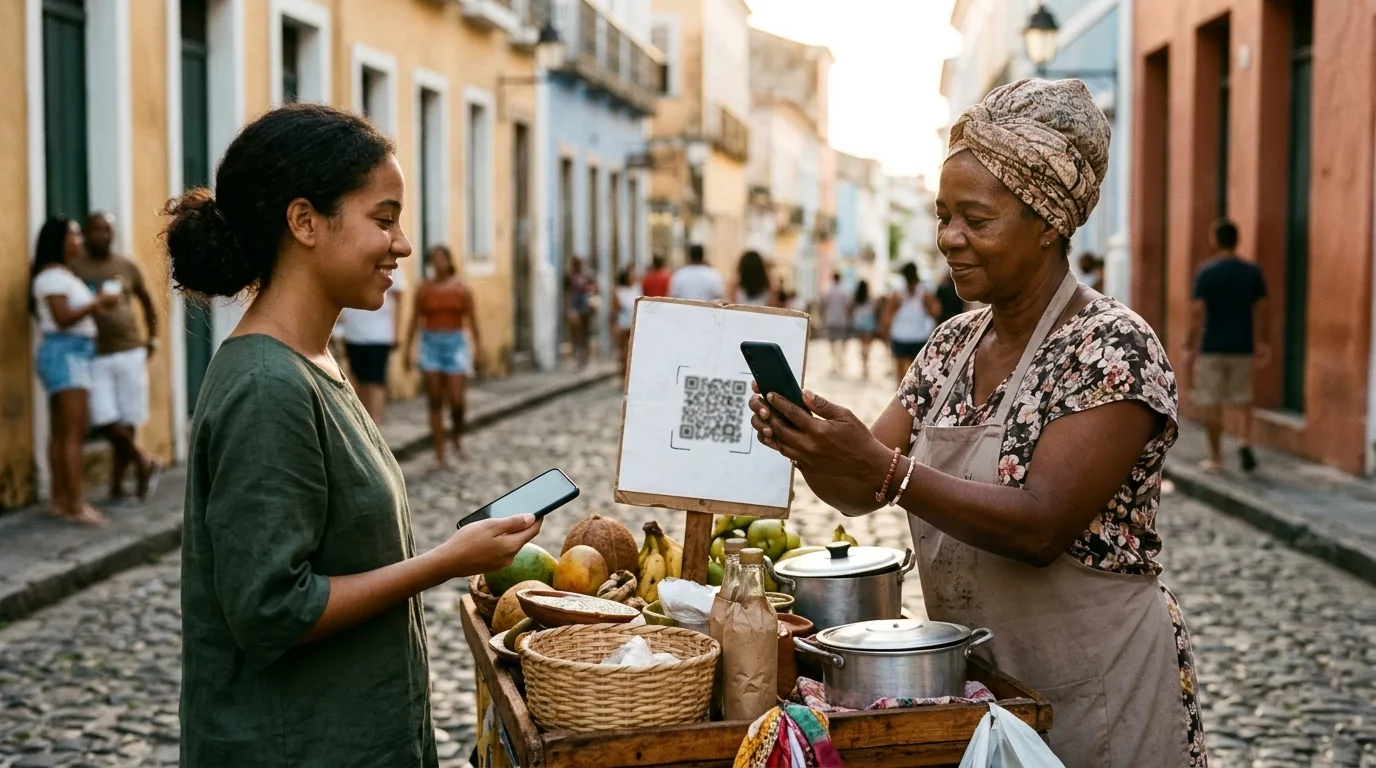
Today Pix, as an infrastructure, only moves reais between institutions inside Brazil. What exists is Pix used as the reais leg of an international payment: the Pix part is domestic, and the stretch between countries is handled separately, the traditional way. A foreign client cannot send a Pix to your account.
Key takeaways
- The Banco Central do Brasil says the Pix infrastructure allows only domestic transactions. There is no date for a Pix that crosses borders, and the study to link Pix to Europe's TIPS is neither approved nor implemented.
- To receive money from abroad, the regular route is a payment order through an institution authorized to operate in foreign exchange, or an international payment service (eFX). Pix can come in at the end, as the payout in reais.
- Eos Cash uses Pix on the reais side: you add reais by Pix, or send dollars received from abroad to a Pix key in Brazil, converted to reais. The calculator shows the full cost before you confirm.
If you heard about "international Pix" in the news, the question is a fair one: can foreigners use Pix, and can a client abroad pay by Pix? This guide separates what exists from what is only under study, and shows how money from abroad reaches Brazil in reais.
Does international Pix exist?
Not as a Pix that crosses borders. According to the Banco Central do Brasil, the Pix infrastructure allows only domestic transactions. There are private models in which Pix is the reais leg of a payment involving another country, but the international stretch does not use the Pix infrastructure.
What the central bank says
The Banco Central's Pix Management Report 2023 to 2025 has a section on the international reach of Pix. The bank says it monitors models that private players implement with institutions in other jurisdictions. They let Brazilians use Pix in other countries and let non-residents use Pix in Brazil, from the apps of foreign institutions (Banco Central do Brasil, Pix Management Report 2023-2025, 2026, checked 4 Nov 2026).
The key point is in how those models are described: after the Pix in reais, the Brazilian institution remits the funds abroad "the traditional way, without using the Pix infrastructure, which allows only domestic transactions" (the report's wording, translated from Portuguese).
What is under study
The Banco Central is assessing links between Pix and fast payment systems in other jurisdictions, through bilateral connections and multilateral hubs under discussion. According to the report, such links "would allow" international remittances and purchases with funds in local currency within a few seconds, and "have the potential" to lower fees. This is a discussion, not a service (Banco Central do Brasil, 2026, checked 4 Nov 2026).
The most recent case involves Europe. On 24 September 2026, the Banco Central do Brasil and the European Central Bank started a feasibility assessment of linking Pix to TIPS, the Eurosystem's real-time settlement infrastructure. Technical, operational, legal and business aspects will be studied. The initiative is not approved or implemented, and no timeline was given (Ministério da Fazenda, page published 5 Oct 2026, checked 4 Nov 2026). For that reason, this guide gives no launch dates.
How do Brazilians already pay with Pix abroad?
In some private models, a Brazilian scans a Pix QR code at a foreign shop and pays in reais. The Pix is domestic and in reais, between the Brazilian's account and a Brazilian institution. That institution then sends the money abroad the traditional way, and the merchant is paid in local currency.
The Banco Central's Cartilha de Câmbio 2026 (its foreign exchange guide) adds that, in some destinations, Brazilian tourists can already use Pix in certain shops. Acceptance varies by country and institution, so it is worth checking before a trip (Banco Central do Brasil, Cartilha de Câmbio 2026, checked 4 Nov 2026).
How do foreigners use Pix in Brazil?
It is the reverse model, and it is still not a foreigner sending Pix to a person. The visitor scans the Pix QR code of a Brazilian business in the app of an institution from their home country. The merchant is paid in reais by an ordinary Pix, and the foreign app debits the visitor in local currency.
Afterwards, the foreign partner sends the funds to the Brazilian partner the traditional way, according to the Banco Central.
A US or European client who wants to pay you cannot choose Pix as the way to send.
How do you receive money from abroad in reais?
The regular routes are a payment order through an institution authorized to operate in foreign exchange, or an international payment or transfer service (eFX). The sender and the receiver must both be identified. If the order arrives in foreign currency, a foreign exchange operation is needed in Brazil.
The Cartilha de Câmbio 2026 explains that a payment order can arrive in foreign currency or in reais, and is usually paid out in reais in Brazil. In foreign currency, there is an exchange operation in Brazil, and the costs are negotiated between you and the institution (see the VET, below). In reais, you receive without an exchange operation in Brazil (Banco Central do Brasil, 2026, checked 4 Nov 2026).
What to give the person paying
According to the guide, the receiver gives the sender a full name, ID, address, the reason for the payment, the bank, branch and account number, plus the identification of the authorized institution.
Above R$10,000, the amount can only be received as a credit to a deposit or payment account at an authorized institution, or by check. eFX services usually work with partners abroad, and the funds may be credited straight to your deposit or payment account.
Where Pix comes in
Pix comes in at the end of the route: after an institution has converted and released the amount in reais, the payout in reais can reach you by Pix. The conversion and the entry of the money into the country are done by the institution, not by Pix.
The guide also warns about the parallel market: it is illegal, nothing assures the money will arrive, and the funds may be mixed with illicit money. Operations should go through authorized institutions.
How does Eos Cash use Pix?
Eos Cash is a global account in dollars, with a balance in digital dollars, and it uses Pix on the reais side. You can add reais by Pix, and you can also receive dollars from a client abroad and send them to a Pix key in Brazil, converted to reais. Eos is not a bank.
To make it concrete, here is an invented example, only for illustration. A Brazilian freelancer issues a US$1,000 invoice to a client in the United States. The client pays by ACH to US routing details. She then converts and sends reais to a Pix key. The example shows no fee and no result in reais: use the calculator.
On the payer's side, a client abroad sends dollars by ACH, wire or SWIFT, and other currencies by local methods. They do not send Pix. To add reais by Pix, the Pix code usually takes minutes to clear, according to the payments partner's documentation.
US routing details work in two ways. The global account can receive a single transaction using US routing details. A fixed routing and account number requires the US virtual account, which is an optional add-on. To understand the concept, read what a routing number is and how US account details work.
The calculator accepts BRL, USD, MXN, COP or ARS as the origin, to a bank account in the destination currency (those currencies plus EUR and GBP), adds the cost of both legs and shows the full amount before you confirm, for transfers of up to US$50,000 per transaction. Today there is no IOF.
For the flow from dollars to Pix, also read how to receive money from US clients while abroad. To see what the account is, visit the global account page.
What should you check before using any service?
Confirm that the institution is authorized by the Banco Central to operate in foreign exchange, or acts as a correspondent of one that is, and ask for the VET before you commit. The guide advises avoiding providers that are not authorized.
The VET (Valor Efetivo Total, or total effective cost) is the full cost of the exchange operation and takes into account the exchange rate, the IOF, fees and commissions. The exchange rate alone does not show the final price, and the institution must state the VET and record it in the exchange contract or receipt. The Banco Central publishes a VET ranking (Banco Central do Brasil, 2026, checked 4 Nov 2026).
Frequently asked questions
Can I send a Pix to an account abroad?
No. The Pix infrastructure allows only domestic transactions, according to the Banco Central. In some private models, you pay in reais by Pix to a Brazilian institution, and it remits the amount abroad the traditional way.
Can a foreign client pay me by Pix?
No. A foreign payer does not send Pix to a Brazilian account. They can pay in dollars by ACH, wire or SWIFT, for example. After an institution converts the amount, the reais can reach you by Pix.
When will international Pix start?
There is no date. On 24 September 2026, the Banco Central do Brasil and the European Central Bank started a feasibility study to link Pix to TIPS. The initiative is not approved or implemented, and no timeline was given.
Do I have to pay IOF when I receive money from abroad?
It depends on the exchange operation, and the VET includes the IOF. This guide gives no rates. The IOF rules for foreign exchange are covered in IOF on foreign exchange in 2026: what it is, how much it is and when it applies.
How does Eos Cash deliver in reais?
You send from your dollar balance to a Pix key in Brazil, and the amount is converted to reais. The calculator shows the full cost before you confirm. Delivery times and Pix timing rules are not covered here.
See the full cost before you confirm
Try the Eos Cash calculator with your amount and see the full cost of both legs before you confirm. Open an account to start identity verification. A passport or a national ID is accepted.
Eos is not a bank. Opening an account is subject to identity verification and supported countries.