

0% APR vs. Deferred Interest: What Contractors Should Know
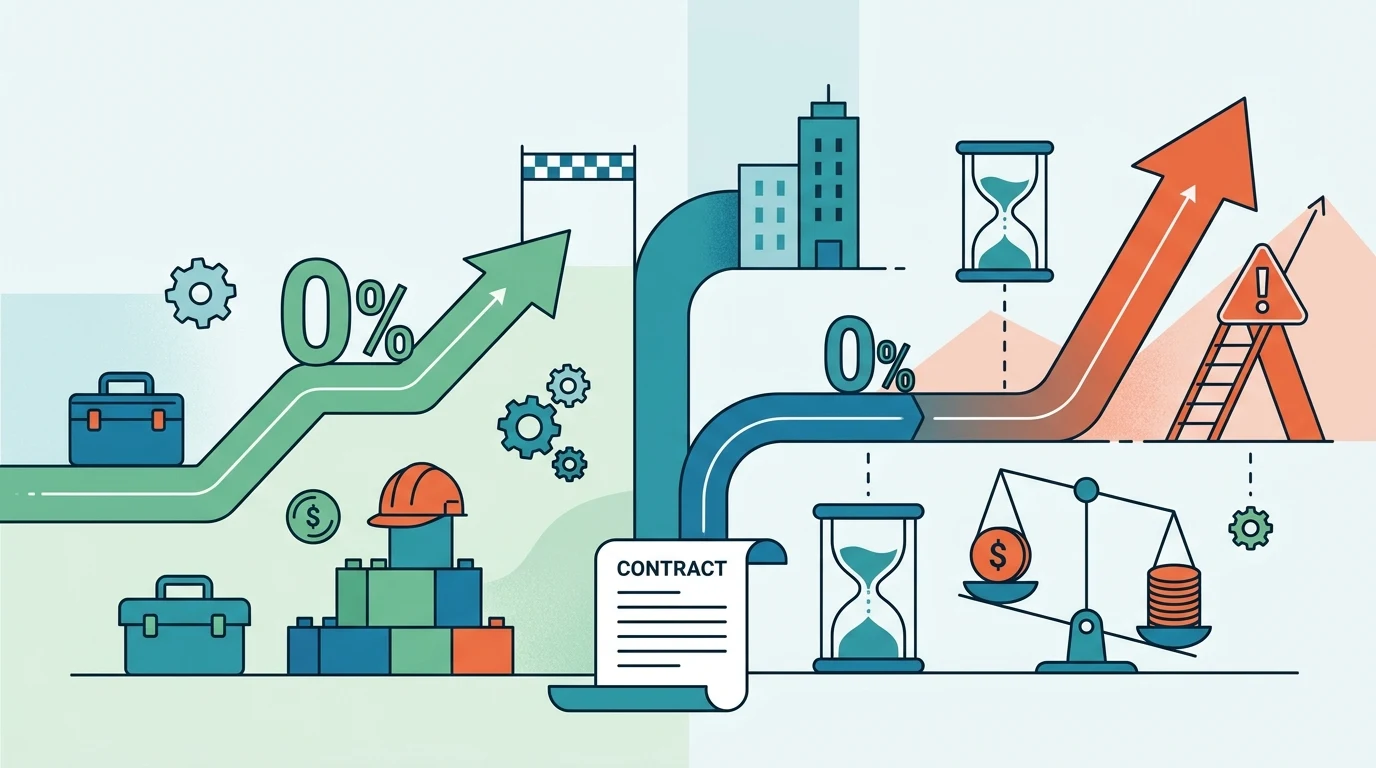
Retail and store credit cards carry an average 32.66% APR, versus 22.7% for general-purpose cards, and 90% of retail cards report a maximum APR above 30% (CFPB, Issue Spotlight: The High Cost of Retail Credit Cards, December 2024). That's the rate sitting behind a lot of "0% special financing" banners the moment the promotional period lapses.
"0% APR" and "deferred interest" get marketed with nearly identical language. Only one of them is actually risk-free. This guide walks through the structural difference, what happens when a customer misses the payoff deadline, and how to vet a promotional financing program before you put it in front of a customer.
> Key Takeaways
> - True 0% APR never accrues interest. Deferred interest accrues from day one at the card's standard rate, often 30%+, and is only waived if the full balance is paid before the deadline (CFPB, December 2024).
> - About one in five deferred-interest promotional balances get retroactively charged interest, on the full original amount, not just what's left owed.
> - A CFPB worked example shows a $4,500 balance paid down to $180 triggering $1,439.55 in retroactive interest at 31.99% APR.
> - Eos Loan is a direct lender with no dealer fee and straightforward installment terms, with no deferred-interest deadline mechanic to explain to a customer after the fact.
See how Eos Loan financing helps you close more projects
What Is the Difference Between 0% APR and Deferred Interest Financing?
With true 0% APR, the balance never accrues interest during the promotional window; with deferred interest, interest accrues from the purchase date at the card's standard rate, often 30% or higher, and is waived only if the customer pays the full balance before the deadline (CFPB, December 2024). Both get advertised as "0% for 12 months." Only one of them means what it sounds like it means.
The distinction isn't cosmetic. It's the difference between a rate that was never charged and a rate that was charged the whole time, then silently waived, contingent on a deadline the customer may not even know exists. Retail and store cards, the kind commonly used for these promotions, carry an average APR of 32.66%, against 22.7% for general-purpose cards (CFPB, December 2024). That's the rate waiting behind the deferred-interest version of the offer.
Most content on this topic is written for someone financing a couch or a laptop. None of it addresses the contractor's actual exposure: what happens to a repeat-customer relationship, and referral pipeline, when a customer you financed gets hit with a retroactive interest charge on a project you sold them. That gap is the reason this comparison matters more for a $5,000-plus essential project than for a retail purchase.
How Does Retroactive Interest Actually Work?
If even $1 remains unpaid when a deferred-interest promotion ends, the lender charges interest on the entire original balance, back to the purchase date, not just on what's still owed (CFPB, December 2024). That's the mechanic that makes deferred interest fundamentally different from a standard 0% intro-APR product, where any interest, if it applies at all, only accrues going forward on whatever's left.
The CFPB's own report walks through a worked example that makes this concrete. A customer finances a $4,500 purchase under a deferred-interest promotion, pays it down responsibly to just $180 remaining, and still misses the deadline. The result: $1,439.55 in retroactive interest, calculated on the full original $4,500 at 31.99% APR, not on the $180 that was actually left.
About one in five deferred-interest promotional balances get retroactively charged interest (CFPB, December 2024). That's not a rare edge case. It's a one-in-five outcome baked into how the product is designed, and it lands hardest on customers who paid down most of the balance and assumed they were close to safe.
Why Do Some Lenders Offer Deferred Interest Instead of True 0%?
Deferred interest lets a retailer or lender advertise "0% financing" while pricing in the expected retroactive-interest revenue from the roughly one in five balances that won't get paid off in time (CFPB, December 2024). It's not a coincidence, and it's not free marketing. Somebody is paying for that "0%" banner, and it isn't the lender.
Installers across the contractor-financing cluster describe a familiar version of this: a customer signs up for a promotional card at the point of sale, feels good about "0% for 12 months," pays it down in good faith, and misses the deadline by a few weeks because of a job delay or a slow month. The retroactive charge shows up on a statement six months after the install is done, and the customer calls the contractor first, not the card issuer, because the contractor is the name they remember.
!A close-up of a financing disclosure document with fine print visible in daylight.
There's a rough analogy on the price side of financing, too. Some point-of-sale lenders recover cost through a dealer fee marked into the system price rather than through the advertised rate, similar in spirit to how deferred interest recovers cost through a retroactive charge rather than an upfront rate. In some home-improvement financing programs, that markup runs 10% to 30% of cash price, in some cases 50% or more, without clear disclosure (CFPB, Issue Spotlight: Solar Financing, 2024). Both mechanics move the real cost somewhere the headline number doesn't show it.
The scale mismatch matters here too. The average promotional purchase under these deferred-interest programs is $637 (CFPB, December 2024), a retail-purchase figure that doesn't map cleanly onto a $5,000 to $40,000-plus essential project. A structure built around a $637 average ticket behaves very differently once it's stretched across a battery storage or water filtration install ten to sixty times that size.
What Should Contractors Watch for When Vetting a Promotional Financing Program?
Before offering any "special financing" program to customers, confirm in writing whether unpaid balances at the deadline trigger retroactive interest on the full original amount, or only prospective interest on the remainder, since that single clause determines the customer's worst-case outcome. Ask the question directly. Don't rely on the marketing sheet to answer it for you.
A short vetting checklist worth running before you offer any promotional program to a customer:
- Get the deferred-interest clause in writing, not a verbal assurance from a sales rep.
- Ask specifically what happens to a customer whose credit tier is lower, since that's the segment most exposed to a missed deadline.
- Check whether the promotional rate is stacked on top of a marked-up system price, which compounds the risk on both sides of the deal.
- Confirm the disclosure terms meet Truth in Lending Act requirements, covered in more depth in what Truth in Lending requires lenders to disclose.
- True 0% APR never accrues interest; deferred interest accrues from day one and is waived only if paid in full by the deadline.
- About one in five deferred-interest balances get hit with retroactive interest, on the full original amount.
- The CFPB's own example shows $180 left owed still triggering $1,439.55 in retroactive interest.
- Eos Loan's installment structure, no dealer fee, 6 to 240 month terms for battery storage, removes the deadline mechanic entirely.
- CFPB, Issue Spotlight: The High Cost of Retail Credit Cards, retrieved 2026-07-31, https://www.consumerfinance.gov/data-research/research-reports/issue-spotlight-the-high-cost-of-retail-credit-cards/
- CFPB, Issue Spotlight: Solar Financing, retrieved 2026-07-31, https://www.consumerfinance.gov/data-research/research-reports/issue-spotlight-solar-financing/
- Wood Mackenzie, US Energy Storage Monitor, retrieved 2026-07-31, https://www.woodmac.com/
- Internal Revenue Service, Residential Clean Energy Credit, retrieved 2026-07-31, https://www.irs.gov/credits-deductions/residential-clean-energy-credit
- Eos Loan program terms, battery storage, 6 to 240 months, no dealer fee, 2026
That last point matters more than it looks. Subprime cardholders represent nearly one-third of store card account volume (CFPB, December 2024), and that's the group most exposed to a missed payoff deadline. If you're financing essential projects for a wide range of credit profiles, this isn't a hypothetical.
Add financing to your installs, talk to our team
0% APR vs. Deferred Interest: Side-by-Side Comparison
The two products look identical in a sales pitch and diverge completely at the payoff deadline; a comparison table is the fastest way to show a customer the difference that actually matters. Walk through this table with anyone comparing the two before they sign.
| Question | True 0% APR | Deferred Interest |
| --- | --- | --- |
| When does interest start accruing? | Never, during the promotional term | Day one, at the card's standard rate |
| What happens if a balance remains at the deadline? | Interest applies only prospectively, on what's left | Interest applies retroactively, on the full original balance |
| Typical rate behind the promo | N/A, interest was never charged | Often 30%+ (retail card average 32.66%) |
| Best fit by purchase size | Any size, since the structure doesn't change at a deadline | Small, short-payoff retail purchases (avg. $637) |
How Does Eos Loan's Model Compare to Deferred-Interest Promotions?
Eos Loan is a direct lender with no dealer fee and installment terms, 6 to 240 months for battery storage, a straightforward structure without a deferred-interest deadline mechanic, positioned as the contrast to both a marked-up dealer-fee program and a retroactive-interest promotion. All financing is subject to approval and eligibility, and Eos Loan does not publish or promise a specific rate.
Eos Loan's program terms are documented, not promotional. Battery storage terms run 6 to 240 months, with flexible terms on EV chargers and water filtration, and there's no dealer fee taken off the top of the funded amount. There's also no "deadline" that changes how the loan behaves. The terms a customer signs at close are the terms that apply through the life of the loan, subject to approval and eligibility.
That structure matters more as the tax landscape shifts. The residential clean-energy credit (Section 25D) ended December 31, 2025 (IRS, Residential Clean Energy Credit, 2025), so financing terms, not a federal credit, carry more of the affordability conversation on residential pitches now. This is general information, not tax advice. Consult a qualified tax professional. Eos Loan financing is not a tax credit, rebate, or incentive; it's a loan a customer repays over time.
!An installer completing a battery storage system install at a home during the day.
For the mechanics of the other side of this comparison, see how dealer fees work and where they hide, and for the broader question of financing structure, see the full 2026 contractor financing playbook. If you're weighing installment financing against a shorter-term structure altogether, how installment financing compares to short-term structures covers that ground directly.
Offer your customers flexible financing on essential projects
Or call +1 833-989-3737 to talk through a financing program for your business.
Frequently Asked Questions
Is 0% APR financing ever risky?
True 0% APR carries no deferred-interest deadline risk, since interest was never accruing in the background. Customers should still confirm there's no dealer fee marked into the price and that terms are disclosed in writing, since a clean rate doesn't guarantee a clean price.
What happens if I can't pay off a deferred interest balance in time?
The lender charges interest retroactively on the full original balance, from the purchase date, not just on the remaining amount, a mechanic confirmed in the CFPB's December 2024 report on retail credit cards. A $4,500 balance paid down to $180 can still trigger over $1,400 in retroactive interest.
How can a contractor tell which type of promo a financing partner is offering?
Ask directly whether unpaid balances at the promo deadline trigger retroactive interest on the original balance, and get the answer in writing before offering the program to customers. If the partner can't answer plainly, treat that as the answer.
Does Eos Loan offer deferred interest promotions?
No. Eos Loan is a direct lender using straightforward installment terms, not a deferred-interest retail-card structure, and charges no dealer fee, subject to approval and eligibility.
Are these financing structures regulated the same way?
Deferred-interest and installment products both fall under Truth in Lending Act disclosure requirements when extended to consumers; see what Truth in Lending requires lenders to disclose for the full breakdown. This is general information, not legal advice.
The Bottom Line for Contractors
"0% APR" and "deferred interest" get sold with the same banner and behave nothing alike at the deadline. The differences that matter:
Before you put a promotional financing program in front of a customer, get the retroactive-interest clause in writing. It's the one question that decides whether "0%" actually means zero.
Become an Eos Loan financing partner
---
Sources
---
{ question: "What happens if I can't pay off a deferred interest balance in time?", answer: "The lender charges interest retroactively on the full original balance, from the purchase date, not just on the remaining amount, a mechanic confirmed in the CFPB's December 2024 report on retail credit cards." },
{ question: "How can a contractor tell which type of promo a financing partner is offering?", answer: "Ask directly whether unpaid balances at the promo deadline trigger retroactive interest on the original balance, and get the answer in writing before offering the program to customers." },
{ question: "Does Eos Loan offer deferred interest promotions?", answer: "No. Eos Loan is a direct lender using straightforward installment terms, not a deferred-interest retail-card structure, and charges no dealer fee, subject to approval and eligibility." },
{ question: "Are these financing structures regulated the same way?", answer: "Deferred-interest and installment products both fall under Truth in Lending Act disclosure requirements when extended to consumers. This is general information, not legal advice." }
]} />
---
About the author: Eduardo Donadi is the CEO of Eos Loan, a direct lender financing essential projects (battery energy storage, EV chargers, and water filtration) for installers, contractors, and resellers across the United States.